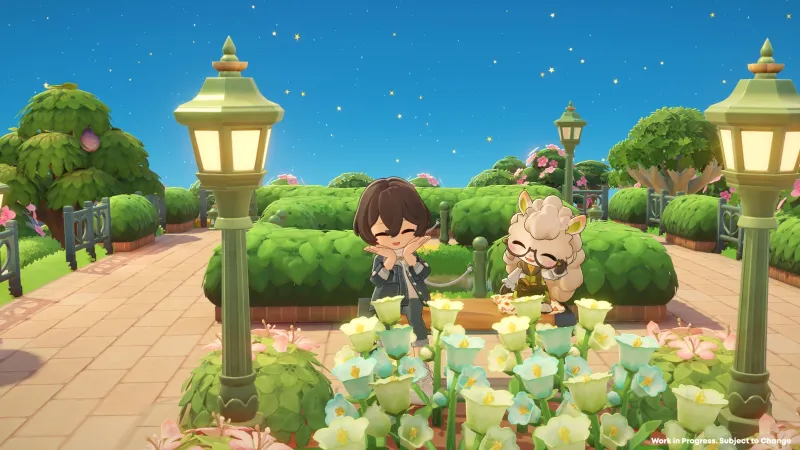



Petit Planet marks Hoyoverse’s maiden voyage into the life sim genre popularized by games like Animal Crossing, Stardew Valley, and, most recently, Pokémon Pokopia. The creators of Genshin Impact, Honkai: Star Rail, and Zenless Zone Zero have crafted well-received, lucrative free-to-play gacha games across several disparate genres; Petit Planet, fittingly, sees it try to attract yet another world of players. It’s been a year since I first played Petit Planet’s initial alpha test, and I spent a couple of more hours exploring its cozy cosmos at the Hoyoverse Media Tour in Seoul, South Korea. Although what I played has not dramatically changed my opinion of the game – it remains a delightful, if familiar, good time – speaking to its lead designer who goes by the single name Murphy and lead artist Yunli Huang helped shed light on how Petit Planet will differentiate itself from contemporaries and its approach to multiplayer, storytelling, and monetization.
The game’s premise centers on a customizable protagonist who sets out to populate their own personal planet (which is about the size of King Kai’s world from Dragon Ball Z). Although you are ostensibly human, everyone else is a talking animal. Your mentor of sorts is a chillax sheepdog named Mobai, who enjoys wearing straw hats and dropping his catchphrase/life mantra “Mo worries” and “Mo Rush.” The business-minded Glenn the Squirrel is a shopkeeper and seems like a cuter, less aggressive Tom Nook. Yunghou is a shy fox who enjoys farming and has the slightest hint of a southern accent. These critters and many more inhabit your planet, which you’ll grow from an empty (but vibrant) rock into a bustling village filled with homes, businesses, crops, decor, and, of course, neighbors.
Story is rarely a hook for a genre that largely promotes creating your own fun through the emergent moments with your neighbors and friends in multiplayer. Still, after Pokémon Pokopia presented an unexpectedly wild and fascinating tale, I ask if players should bother getting invested in a grander narrative à la Genshin Impact. The short answer seems to be “not so much.”
“Unlike other Hoyoverse games, there is no such main plot,” Murphy explains in my group interview. “There will be a main story at the beginning, but the main purpose is just to guide the players, get more familiar with the setting and the world. But the whole narrative of this game will be more fragmented. For example, if you look at those descriptions of those items, there will be a lot of content and narrative behind it. If you look at the description of creatures, many of them are real creatures in real world, and you get to learn more knowledge of this creature by reading those descriptions. And also, we’ve developed a very comprehensive narrative for each of our neighbors, so that is also part of our, called like, main plot, main narrative, because we want to make this world more like more lively and a more livable world. So that is how we treat narrative in this game.”
While players who enjoy a substantial story to propel them through a game may be disappointed, those looking to unwind with a laid-back experience should be pleased. Hoyoverse is designing Petit Planet to be a no-pressure experience to enjoy at your leisure, hence why it emphasizes it as a life sim more than a management sim. There are no complicated stats to manage; simple inputs make it easy to pick up and play; imperfection is encouraged, with Hoyoverse comparing the experience to doodling as a child: your creation may not be perfect, but you had fun bringing your imagination to life.
I spent the first hour of my roughly two-and-a-half-hour session starting from scratch to see if any notable changes were made to this introductory portion in the last year. If there are any differences, they’re imperceptible because I wen went through the same onboarding of learning how to catch bugs and fish, building your first home, inviting your first neighbor, and farming crops, all while growing a magical sapling that, after performing enough tasks, blooms into a full tree that brings new life and mechanics to your world as it grows. Performing special tasks for residents, from completing requests to simply interacting with them, grows their bond, which, when high enough, will entice them to move in. For veteran genre fans, it’s a familiar song and dance. What I did notice this time around is how refreshingly quick the onboarding is. You have all of these foundational mechanics within the first 45 to 50 minutes, which is a nice pace. It was a good refresher for some foundational mechanics I’d forgotten since I last played, but it created an appetite to dive deeper.
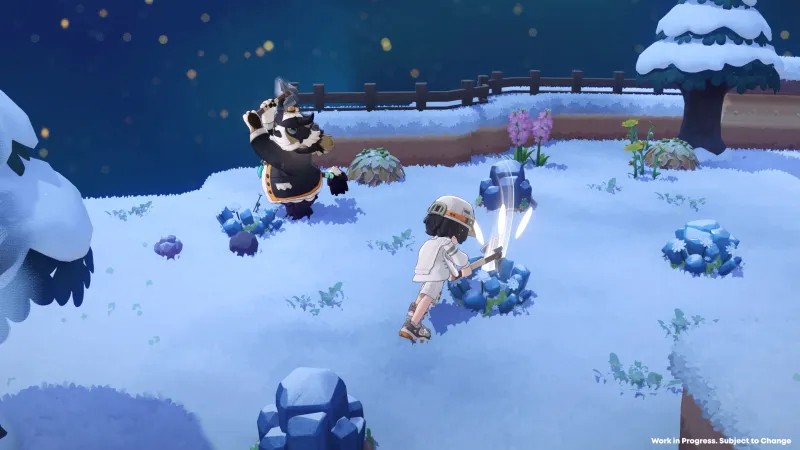
Thankfully, Hoyoverse provided a second build set many hours into the game to give an idea of how planets can evolve. This build was set during winter, one of Petit Planet’s revolving seasons that alter the environment and introduce themed cosmetics and decor for players and residents. Sporting winter gear, I ran around the snow-covered planet, which was densely populated with shops, homes, and neighbors. I was initially greeted by unfamiliar faces named Trixie and Kookoo, who provided weather forecasts and news reports reminiscent of Isabelle from Animal Crossing and Callie and Marie from Splatoon. My sparse quest log was tricky to tackle since they revolved around mechanics I had no context for, such as setting up Vignettes. These are essentially templates for unique scenes filled out by dropping the correct furniture pieces in their layout; in this case, I had to set up an outdoor movie on the beach.
I only spent roughly an hour with this late build, and my biggest takeaway was simply how dense and lovely the village looked. A lot of work went into crafting this build, which boasted a farm filled with different crops (with unlockable recipes to create dishes from them), crafting tables to build furniture from collectible blueprints, and several shops, including Glenn’s to purchase a revolving selection of decor items. None of what I saw surprised me, however. Petit Planet so far checks many of the boxes you’d expect and want from a life sim. My cursory tour of a later-game planet did little to reveal any big new ideas, but what I did experience seemed perfectly cromulent.
My biggest question regards multiplayer. As much as I enjoy Animal Crossing: New Horizons and Pokémon Pokopia as solo experiences, playing with friends feels like a mean joke because of the tedious number of hoops to jump through just to invite other players into your world. And even once your buddy arrives, interactions are disappointingly limited. When I ask if Petit Planet offers a comparatively frictionless multiplayer experience, Murphy vaguely assures smoother sailing. “The multiplayer experience is a very important part of our game because, just as the interaction with NPCs, the interaction with other players is also a form of building up emotional connection to this game, and we want to provide that kind of experience to our players.” More specifically, Murphy cites features such as dynamic server load adjustments based on player counts and the option to allow or ban visiting players from taking resources from your planet to prevent griefing.
As a free-to-play Hoyoverse game, monetization is a major talking point. In Petit Planet’s case, the team agrees that rolling for neighbors gacha-style would be strange and defeats the spirit of the genre. Instead, all monetization will revolve around cosmetics; players can unlock new furniture and themed decor sets, outfits, and other cosmetic accessories for their character. Unlocking a full themed set of decor earns currency points, and there are myriad reward meters to fill for performing mundane tasks like greeting residents or catching bugs. It remains to be seen if and how Petit Planet’s progression begins nudging players into opening their wallets, but Hoyoverse promises it will be an experience that deemphasizes grinding.
I also briefly checked out the recently announced Switch 2 version of Petit Planet. My impressions after about 15 minutes of playtime: it’s fine. It sometimes ran noticeably hitchier than the PC version I spent most of my time with, but it seems perfectly adequate so far and, hopefully, will be a smooth experience when it launches sometime next year.
Since life sims require more than a couple of hours to fully reveal their quality, it was tough to get a read on Petit Planet even with this new showing. The game looks beautiful thanks to Hoyoverse’s signature sharp and colorful visual style. It has a relaxing vibe, and feels mechanically decent for the most part. In short, it seems broadly fine and like a respectable take on the genre. I suspect its biggest appeal will be that it will receive what Animal Crossing: New Horizons lacked: years of constant, substantial support.
Hoyoverse is very good about keeping fans of its games well fed with regular updates for years on end, and I don’t expect it to stop now. The idea of a seemingly well-made spin on Animal Crossing that’s free to download and, unless it completely bombs, will almost certainly receive years of new content is enticing on paper. I imagine this is the reason Petit Planet is coming to Switch 2 next year, where it can lure in Animal Crossing and Pokopia players before other consoles. PC and mobile players, meanwhile, must only wait until December 4 when Petit Planet fully launches to see if it has the chops to stand alongside the coziest giants of the genre.