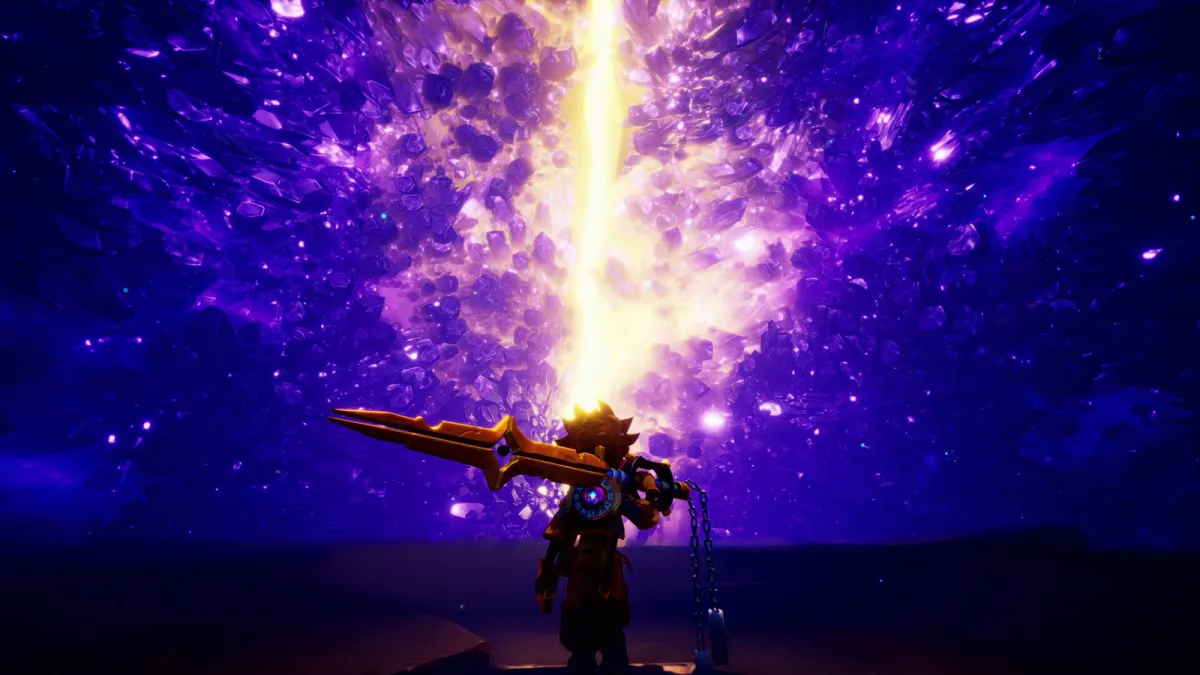






When I ask Onimusha: Way of the Sword producer Akihito Kadowaki and director Satoru Nihei if they feel the pressure of having to follow two well-received Capcom releases this year, Resident Evil Requiem and Pragmata, they candidly confirmed they do. The pair even shares that the producers for those two games routinely wish them good luck on keeping up the momentum whenever they cross paths at work. I can’t imagine how nerve-wracking that could be, especially since Way of the Sword is the first Onimusha game in many years, adding additional pressure to get it right for starved fans. But if what I played of the game during Summer Game Fest is any indication, Kadowaki and Nihei may have little to worry about.
Onimusha: Way of the Sword stars a fictionalized version of the real-life master swordsman, Miyamoto Musashi (whose in-game likeness is modeled after the late actor Toshiro Mifune). When demons known as Genma invade Kyoto, Musashi becomes unwillingly bound to the Oni Gauntlet, a powerful heirloom that can also talk. The gauntlet, who identifies as Shizuka, combined with Musashi’s unparalleled swordsmanship, makes the pair the perfect heroes to purge Kyoto of this threat, much to the reluctant Musashi’s chagrin.
My demo unfolds midway into the adventure, with Musashi encountering a blind woman outside of a village. The chipper lady says she can tell Musashi resents the Oni gauntlet and the trouble it’s brought him and offers a solution: visit the Yasui Konpiragu Shrine in town, where all of his problems will be solved. Upon entering the village, which is enveloped in a dreamlike golden glow, I encounter unsettlingly cheery citizens who tell me how happy they are to have had their wishes granted by a mysterious god. An old man suffering from chronic knee pain sought relief, so his leg was amputated. A couple who wished to stay together forever were turned into a pair of smiling, creepy dolls. Neither Musashi nor Shizuka knows what to make of this strange place, but they know it can’t be good. Shizuka suggests contacting the soul of a heroic oni named Yorimasa, who died in battle, to help sort this place out.
Unfortunately, visiting Yorimasa’s grave yields no results, so Shizuka suggests calling upon the help of the Eight Stout Pillars. These talking statues stand high on ceremony, but only five are present; three of their brothers are missing, and we’ll need to find them to receive their collective blessing. Exploring the village to find these stone figures leads to many combat encounters, giving me a chance to see how the action has evolved since I played an earlier section of the game last August. The answer is that it’s still very good.
Hacking foes apart still feels somewhat deliberate yet flashy, but countering and parrying is Way of the Sword’s bread and butter. Enemies have health and stagger meters, and parrying attacks whittles down the former, which can open them up to attack. Parrying feels great thanks to satisfying feedback and smooth counter animations (achieved using motion capture using a real-life sword expert, according to Nihei), such as slicing off a limb or carving a foe in half. Projectile attacks can also be deflected back to their senders. My demo featured floating demonic heads that spat energy balls; deflecting those attacks lodged them right back into their mouths, causing them to explode into a mess of blue ooze.
Auto-directional blocking allows Musashi to guard against attacks from all sides, while dodging attacks at the last moment lets Musashi shift behind them in a near-supernatural fashion, opening them up to counterattacks. Successive parries or blocks build respective meters that, when full, cause Musashi’s sword to radiate a blue aura. When in this state, Musashi can cut down multiple foes in quick succession. Filling the dodge meter unleashes a different but still devastating multi-hit attack. Break Issun attacks, flashy finishing moves that act as emphatic exclamation points to encounters, have been made even more impactful over the past few months due to player feedback, Nihei shares.


Defeated enemies drop souls that I manually absorb into the Oni gauntlet by holding a shoulder button. I’m doing this a lot because I choose to rush into most encounters head-on despite having the option to stealth execute oblivious foes. I enjoy the combat that much. Plus, I want to master parrying, given how important the mechanic seems to be for success. I collect the three missing Stouts and return them home. As a reward, they use their power to condense the malice in the area into one spot, making it easy to identify the Genma responsible for granting these so-called miracles.
I return to the village, which has lost its idyllic glow and is now tinted in ashen grey. I spot a black mass of energy ahead, and upon reaching it, I’m treated to a flashback. A woman is shown praying to a shadowy Genma known as Rasho-gan, who asks her if she’s “joining” or “severing”. The woman cries about how she’s been forced to play the Shamisen every day and is scolded by her mistress when she plays badly. She doesn’t want to practice playing her instrument anymore. Rasho-gan offers a twisted solution: severing the woman’s fate using her fingers. He takes out a large pair of scissors. Unfazed, the woman offers her hands, and Rasho-gan amputates her digits in one slice (off-screen, thankfully, but the sound is gross nonetheless) as Musashi watches in shock and horror. The woman barely flinches and is quite pleased to realize she’ll never have to play her instrument again.
Rasho-gan admires his bloody prize as Musashi remarks about how messed up this situation is. Suddenly, what we thought to be a magical recording of Rasho-gan from the past suddenly turns and addresses Musashi directly. The creature attempts to sweet-talk Musashi into letting him remove the gauntlet by taking his entire arm; Musashi is nearly bewitched by Rasho-gan’s supernatural charms before Shizuka yells for him to snap out of it. Good thing, too, because Musashi catches Rasho-gan’s massive blade at the last moment, kicking off one hell of a boss fight.

As the battle starts, Rasho-gan takes his true form: a disturbing humanoid mass of human arms and hands. A defiant Musashi tells Rasho-gan he won’t be getting anything from him. Rasho-gan wields a large sword and connects to surrounding objects using what I can only describe as spectral umbilical cords. Hacking away wildly at this boss has limited success, but I soon realize that parrying will win the day. Playing defensively and deflecting his tricky attack patterns drastically lowers his stamina meter, creating openings to retaliate. This intense sword dance reminds me of the best battles in Sekiro: Shadows Die Twice, which is probably the highest praise I can offer. I wouldn’t say Way of the Sword’s parry is just as good as Sekiro’s, but the intensity and satisfaction of deflecting attacks is definitely in the ballpark.
Other attacks can’t be blocked, such as when Rasho-gan uses his cords to pick up large objects, such as boulders, trees, or even entire buildings, to throw at Musashi. Quickly firing Musashi’s bow to sever these connections causes the objects Rasho-gan holds to crash down on him, dealing damage. A lot is happening in this fight, but I find my rhythm parrying his attacks and interrupting his ranged moves, until I finally bring Rasho-gan to his knees. Unfortunately, I don’t get to finish him, as Rasho-gan makes a run for it. He doesn’t get far, however, thanks to a fatal intervention from a character I won’t spoil.
“That particular boss, Rasho-gan, rather than being kind of born from a particular kind of monster or mythological creature, is more kind of tied to the location itself,” explains Nihei through a translator when I ask about the inspirations for Rasho-gan. “So the place that you fight him in, Yasui Konpiragu temple in Kyoto, it’s a real temple. And that place has long had legends associated with kind of bonding and separating fates, and there’s a lot of imagery tied to that with the threads and cords. So kind of thinking about that location and what kind of twist [we] could put on it is kind of where that boss was essentially born from.’
I loved this battle, and it ended my time with Onimusha: Way of the Sword on a high note. Every Sekiro fan has probably been chasing that game’s highs since 2019, and while I won’t say Capcom’s action game is the second coming of From Software’s ninja classic, it’s one of the closest to reach that style while still feeling distinctly Onimusha. Tack on how much of an entertaining pair Musashi and Shizuka seem to be, and I can’t wait to face everything this corrupted Kyoto throws at me on September 25.