


Australia Did It: End-of-the-world Railway Defense Business is a game I catch myself playing in my head long after I shut it off. Though it uses turn-based strategy as its base, it expands beyond the genre’s regular confines, blending elements from roguelikes, puzzle games, bullet-heaven titles, and the tower-defense genre. The result is an experience that demands wide-scale experimentation and rewards improvisation.
In a post-apocalyptic world where the Atlantic Ocean has dried up, you risk your life to ensure your shipment reaches its destination. Riding from station to station by train, you must build your team amid your many missions as various mutated creatures, malicious machines, and coordinated soldiers attack your convoy. Lore is doled out piecemeal and serves mostly as background dressing, but each time I learned more about the world, I became more curious.
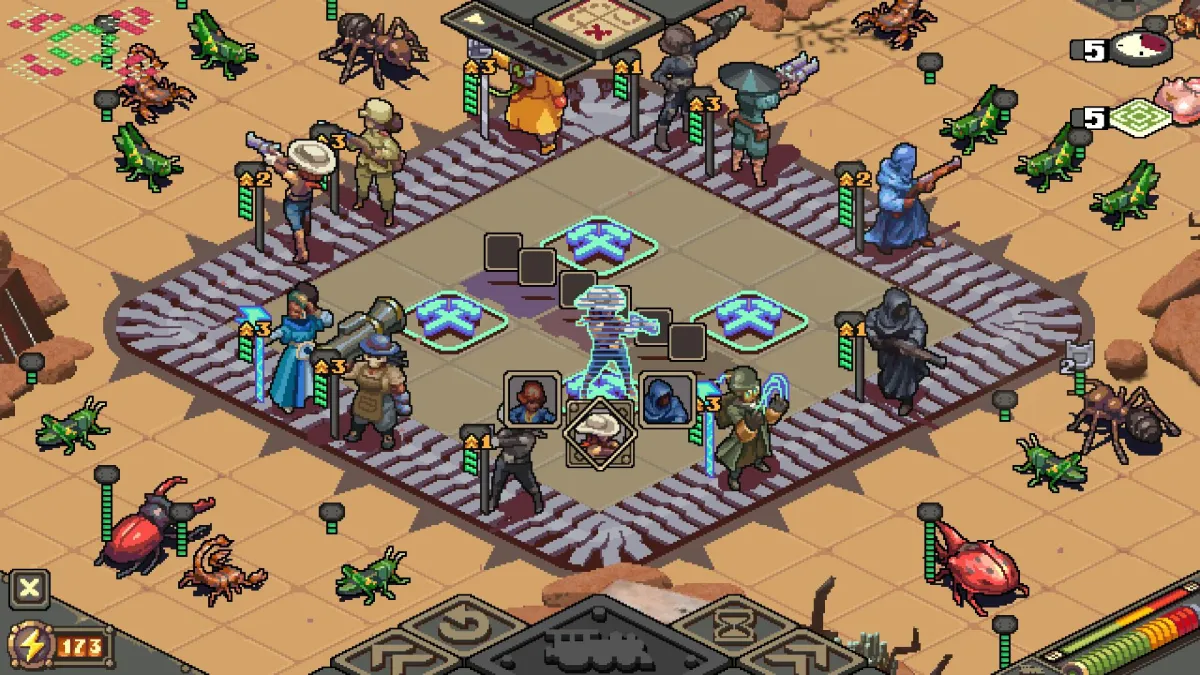
To survive the harshness of the wasteland, you must use cindermint, an in-game resource gained for surviving turns and killing enemies, to spawn defenders, with three base classes to choose from. The revolver-wielding Gunslinger is your primary damage dealer, while the Radshot applies corrosive radiation damage, and the Nomad offers a close-range shotgun blast with knockback.
Those base-level characters offer solid variety upon which to build. And that’s where the main hook for Australia Did It comes in: experimentation through combination. In the midst of battle, you can merge two units of the same level to create new, more powerful defenders, influenced by the traits of those used in the merge. At the onset, you can merge two Nomads to create a level 2 Nomad with increased damage and knockback, but the real fun comes in combining disparate units to create completely new characters. Even now, more than 15 hours into my gameplay, I’m still concocting new combinations I want to try on my next run.
By the end of my first successful run, I had multiple level 6 characters, including a railgun-toting heavy, mages who steal health from enemies and redistribute it to nearby allies, a drone that can move beyond the walls of the station to attack enemies directly, and, my personal favorite, a dual-shotgun-wielding one-man wrecking crew. However, many of these higher-level units also possess drawbacks to consider, like the railgun scorching all adjacent tiles or the drone running out of battery if it’s outside the walls for too long. Though I started keeping notes in my head about which combinations led to my favorite results, I was grateful for a comprehensive compendium that tracked the tens of unit types I unlocked through this rewarding experimentation.
The meat of the experience places your squad on a 25-tile square board with enemies spawning from the four principal directions. Thoughtfulness and positioning are crucial, as each unit on your squad possesses different traits and movement efficiency, as do the encroaching enemies. Basic enemies often make a beeline toward the station, while others may take a weaving route or keep their distance and blast you at range. Improvising and adjusting your strategy on the fly is the most engaging part of Australia Did It, and when you perfectly adapt in the moment, or escape the scenario by the skin of your teeth, there are few better feelings I’ve experienced in a game this year.
Your goal in this phase is to simply defend the station and gather resources to strengthen your squad before evacuating and moving on to the next area. Considering each unit’s strengths, weaknesses, and capabilities while strategically positioning them around the station takes some getting used to, especially during the more chaotic stages. I fist-pumped as I watched the train pull out of a station that was about to crumble, and I lamented the loss of high-level units I had to leave behind to ensure the survival of the convoy. The process is ceaselessly thrilling, even as you begin to see how the gears work under the hood. I just wish I could say the same about the intervening train sections.
Once you escape the turn-based strategy portion, your surviving squad members hop aboard the train and chart their route. Using a basic map, you choose your next stop, with factors like enemy types and modifiers shown to you ahead of time. The top-down train segments between station-defense stages are largely passive; the units you evacuated from the previous station automatically attack swarming enemies with the same traits and perks they have in the main gameplay areas. You can aim a focus cone to instruct your units, but you’re at the mercy of the units you’ve brought. You can trigger an ultimate ability to send your defenders into overdrive, but I rarely needed it.
While I love the idea of intentionally crafting a team that’s good at both the turn-based strategy and bullet-heaven transport sections, I was never fully engaged getting from point A to point B. Instead, I often caught myself checking how much longer before my train arrived at the next station; these sections can be completed in a minute or two, but that doesn’t alleviate the feeling that it’s a step down from the other gameplay. These novel portions aren’t bad by any means; they’re merely an average part of an otherwise excellent experience.
Looking back on the hours I poured into Australia Did It, the forgettable train segments will occupy only a small part of my memories, just as they do in each run. Instead, what will stick with me for months to come are the creative combination mechanics, the outstanding turn-based defense system, and the thrill of uncovering the mysteries of this bleak, yet engaging world.