



Blizzard’s hot streak continues with Midnight, World of Warcraft’s latest expansion, which further builds atop (and below) the world of Azeroth. The main storyline offers poignant commentary on religion, family conflict, and generational trauma through its well-written characters. The long-requested housing feature finally debuts, offering impressive building and customization systems and introducing a new reward vector that enriches almost every activity in the game: decor collecting. Furthermore, Blizzard’s reimagining of older zones like Quel’Thalas and Zul’Aman makes them a delight to revisit; I get as much enjoyment exploring these revamped locations as I do new places. While I still have many more hours ahead as I explore the full breadth of Midnight’s endgame activities, the expansion’s new core features and questing experience are stronger than ever.
Serving as the middle chapter in The World Soul Saga trilogy, Midnight keeps the spotlight on antagonist Xal’atath, who has sundered the skies above the Blood Elves’ homeland as her void army, The Devouring Host, assaults The Sunwell, a fount of arcane and light energy that’s sacred to the elves for its beneficial effects on their society. The narrative sends players on an exciting tour of a revitalized Quel’Thalas, first introduced 20 years ago in The Burning Crusade, its many locations brimming with new activity as they reflect years of prosperous change.
The capital city of the Amani Trolls, called Zul’Aman, was previously only an instanced dungeon. However, Blizzard has expanded Zul’Aman into a full zone with breathtaking, moody vistas. Ancient pine trees jut out from the fog-ridden landscape, their natural beauty contrasting the cold, carved stone ruins of a once-thriving troll empire. Impressively, the whirling voidstorm above the Sunwell is visible from both neighboring zones, a vibrant showcase of Blizzard’s skybox tools as well as an excellent grounding mechanism.
We once again assume a supporting role in the political stories of Azeroth’s denizens, as Midnight’s story centers on themes of generational loss and the long-lasting results of war. Characters like Zul’Jarra, granddaughter of a notable Amani patriarch, and Arator, a Blood Elf paladin struggling to follow in his father’s footsteps, represent a new generation of leaders whose reluctance for bloodshed is in stark contrast to their elders’ past conquests.
Upon completing significant quests, most characters offer an option to “stay awhile and listen,” granting agency as to whether you’d like to hear more exposition or to keep the adventure moving. Most of these optional conversations are worth hearing, often serving as a lens into deeper emotions and motivations, though some conversations feel like nothing more than exposition dumps. It’s nice to have the choice, regardless.
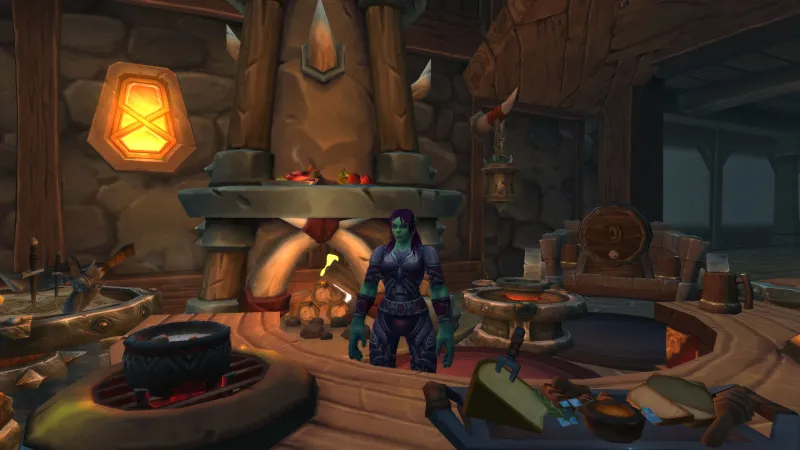
My favorite feature, player housing, fundamentally improves World of Warcraft by giving adventurers their own plot of land to build a house and showcase their creativity and relics of their achievements. Nearly every activity in Midnight rewards players with new housing decorations; even legacy professions, dungeons, and raids grant new rewards, giving good reason to interact with decades-old content.
Players can place decor with a simple grid system; the advanced building mode enables 3D gizmos to manipulate an object’s scale, rotation, and position data. The latter provides all the tools necessary to kitbash disparate objects into new ones. For example, clipping a stone fountain into the wall can make for a stylish bathtub, or you can shrink a cooking fire and hide it in a metal box to make a rudimentary cooking appliance. This process is an incredible creative exercise and gives the same sense of satisfaction I might get from solving a complex puzzle.
While I’m still working my way through endgame content, including several raids, battlegrounds, and a target-hunting Prey system, Midnight’s core experience is great. As the second entry in a trilogy, Midnight effectively fleshes out returning characters and blurs the line between good and evil in interesting ways. Ending on a dark note, this middle chapter creates more questions than answers, and serves as a great staging ground for the story’s final act. While the conclusion is still years away, I’ll happily devote that time to decorating and, inevitably, renovating my new abode. Now more than ever, Azeroth feels like a home away from home.


