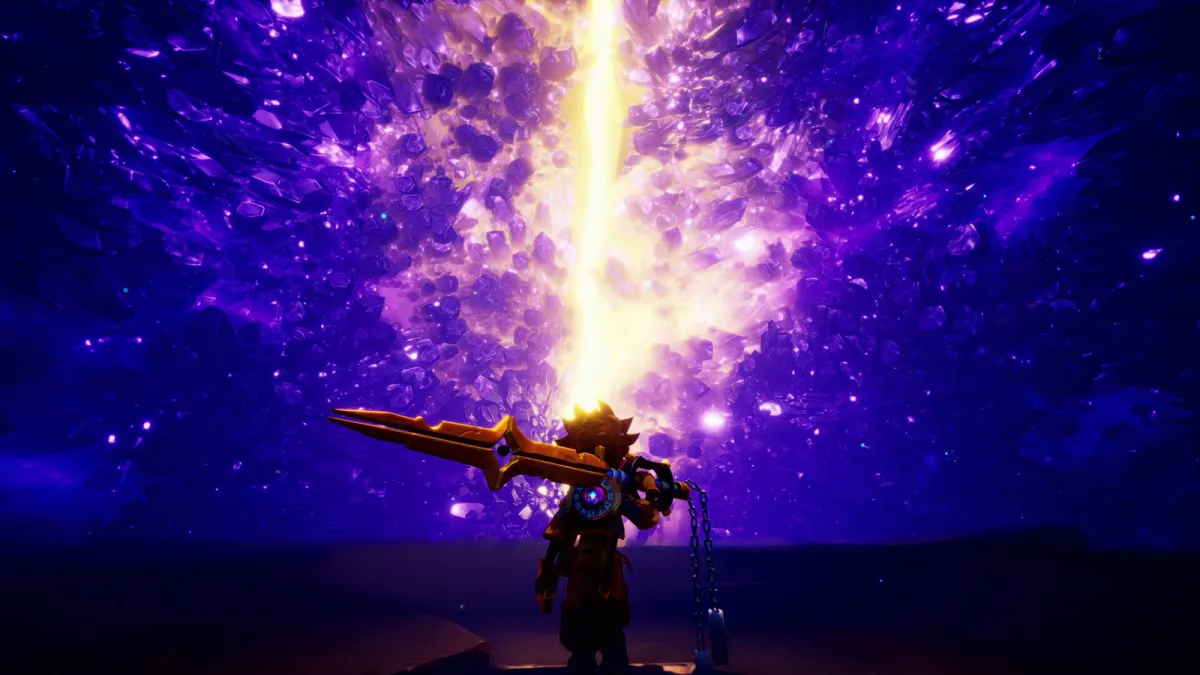





Despite starring a hero clad in red, it’s clear that The Adventures of Elliot: The Millennium Tales is a game trying to fill the proverbial green tunic worn by Nintendo’s star swordsman, Link. Between its talking fairy, time-traveling narrative, and arsenal of weapons/puzzle solving tools that includes bombs, a bow, and a boomerang, the comparison is impossible to deny. While it arguably improves on some elements, like its enjoyable combat system, I spent most of my time with Elliot entertained, but never satisfied. Link did it better, but my 25 hours in the land of Philabieldia was pleasant nonetheless.
Elliot earns his subtitle of “the Millennium Tales” thanks to its story, which spans four ages of its continent’s history. By passing through Doorways of Time, Elliot embarks on a quest to save the kingdom of Huther in his home time period. The story, while simple, is the classic sort of adventure publisher Square Enix is known for, with magical secrets, sages, and a long-lost sacred sword. But while time travel is an interesting hook, I was left frustrated at how little each age varied from the last. The main town and its people shift drastically, but enemies don’t vary much from era to era, and the overworld doesn’t change enough to feel new. I often would be ushered back into a new time period, meet the people of a new town, and then go through the same fields, caves, and dungeons I had already explored further down the timeline.
For most of the game, Elliot also doesn’t seem to impact the timeline, which is slightly disappointing. He participates in major conflicts, but the flow of history isn’t altered – his appearances are canon events, so nothing drastically changes when you return home. The time travel functions more as a tool to explore the land’s history at each of its most pivotal moments. You’re far more likely to travel to the past to learn about a problem’s context than you are to solve it before it occurs. The only exception is the game’s true ending – it’s the first time the causal relationship between eras is really felt in the story, rather than just worldbuilding. This great sequence, which added eight hours onto my playthrough, is absolutely mandatory if players want to understand Elliot and his world, as it’s the narrative’s proper conclusion. It’s just a shame the story’s most unique element takes so long to truly pay off, and I hope most players don’t put the game down before then.


The Adventures of Elliot’s greatest strength lies in its protagonist’s wide arsenal of tools, all unlocked fairly early in the game. There are seven main weapons to equip and customize with Magicite, Philabieldia’s enchanted gems. These crystals alter your attacks in various ways, making them hit harder, cause elemental status effects, or add other weapon-specific traits. I made my boomerang extra large and lengthened its time in the air, allowing me to shred enemies with a buzzsaw-like attack. Meanwhile, my massive hammer knocked foes far away and caused defeated enemies to explode. It’s a great system, and I regularly experimented with my weapons and builds.
I wish there were a greater variety of enemies, as you battle most of them in the first 10 hours. Luckily, The Adventures of Elliot has a bonus drops feature, which increases enemy rewards as you defeat foes without getting hit. Despite combat growing stale towards the end, I enjoyed feeling like I had mastered the existing enemy types, blazing through familiar monsters to max out my gains to make extra cash.

Your fairy companion, Faie, also gains abilities throughout the adventure, and while they’re mostly used for puzzle-solving, they also add fun wrinkles to fights. You can also play challenges focused on these abilities in the menu, shooting for high scores and unlocking music tracks to listen to in-game. Faie herself, however, is the game’s most grating feature. Her high, bouncy voice would not be out of place in an episode of Dora the Explorer, and she talks nonstop, usually over-explaining basic concepts or simple observations. Faie manages to put Navi’s cycle of “Hey, listen!” to shame, even when dialing down the “chattiness” setting in the game’s menu. She’s also the only companion to follow Elliot between eras, so you’re stuck with her, whether you like it or not.
Despite the successes of The Adventures of Elliot: The Millennium Tales, I can’t help but feel it doesn’t make full use of its time-travel potential, both in its overworld and in its story. Still, while it’s not particularly exceptional or exciting, it is both adequate and effective. I doubt The Adventures of Elliot will replace Zelda in anyone’s list of favorites, but across my roughly 25 hours, I was always glad to pick my Switch 2 back up and play some more.