




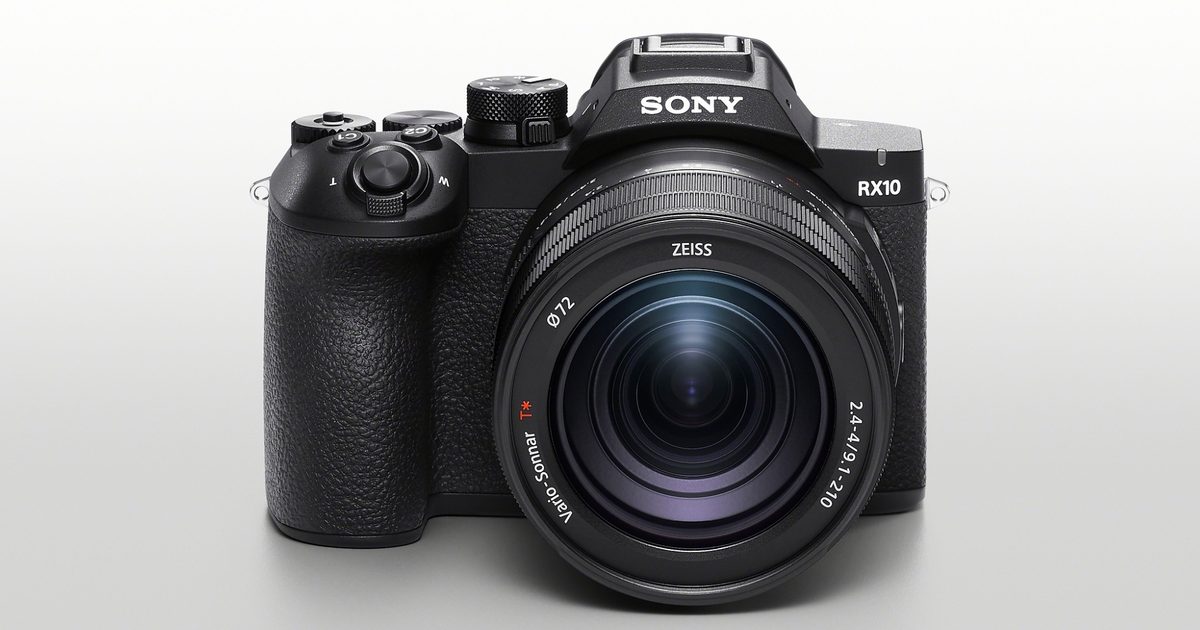
Sony just revived its most beloved all-in-one body camera with autofocusing AI from its professional Alpha mirrorless lineup.
Everything that made the previous generations great is still there. The ZEISS Vario-Sonnar T* lens covering 24mm to 600mm at F2.4 to 4.0, the 1.0-type stacked sensor, and the compact form factor.
So what’s actually new in the RX10 V?
What’s new is real-time recognition AF, driven by an onboard BIONZ XR AI processor, that automatically identifies people, animals, birds, insects, cars, trains, and airplanes, and changes how the camera performs in real conditions.
Combined with blackout-free continuous shooting at 30 frames per second and 60 AF/AE calculations per second, this is the first RX10 that can genuinely keep up with an egret changing its direction mid-flight.
Besides photography, video got a major leap as well. The RX10 V records 4K at 120 fps (with a relatively narrower field of view), while the RX10 IV tops out at 4K at 30 fps.
Battery life improves by 50% over the previous model, with the NP-FZ100 pack delivering approximately 630 shots. There’s a new Quad-VGA OLED viewfinder onboard as well, with 3.68 million dots that help you compose clearly in direct sun (via Sony).
Is $2,299 worth it for a bridge camera?
It’s a fair question, especially since the RX10 IV launched at a lower price point: $1,699.99.
Here’s my honest answer: if you shoot wildlife, birding, sports, or travel and want a single lens that covers your entire range without having to swap lenses all the time, $2,299 buys you something no mirrorless kit offers in a single body.
You’re paying for the convenience of not having to carry a heavy bag with multiple zoom lenses. Anyway, the Sony RX10 V will be available to purchase in the United States starting in August 2026.
Sony’s RX10 series has quietly maintained a devoted community of photographers who prefer a single all-in-one body over a multi-lens mirrorless kit, and the RX10 V closes the autofocus gap that previously separated the RX10 from Alpha cameras.