


This feature originally appeared in the Ninja Gaiden 4 issue of Game Informer magazine on August 26, 2025. It has been brought in front of the paywall for your reading pleasure! To get earlier access to articles like this, head here to subscribe.
Introduction
I knew it was going to be okay when Roberta Williams said she shared my creative love of theme parks. The Zoom changed from a picture of my face to a picture of an idiot smiling like he just got whacked in the head with a bag of candy. This was part of what I would legitimately describe as one of the best moments of my life. There’s an old Saturday Night Live sketch with Chris Farley completely crashing out as he talks to Paul McCartney, and I’ll be real: Roberta Williams is more or less my Paul McCartney.
Let me back up.
They say never meet your heroes, right? Ostensibly because meeting your heroes takes them off that glorious pedestal when you learn they’re only human. Or, you know, complete jerks. As someone who’s spent over a decade writing comedy for both television (Mystery Science Theater 3000, The Tonight Show Starring Jimmy Fallon) and video games (Kid Icarus: Uprising), I can assure you the latter isn’t always the case, but it’s definitely sometimes the case. I have absolutely met someone I spent years worshipping as a kid and left the conversation thinking, “Oh God, their only memory of me will be hate.” As Troy said in Community, you can’t disappoint a picture. And buddy, I did not want to disappoint the person in that metaphorical picture.
Always Meet Your Heroes
Always Meet Your Heroes
I recently wrote a book called Good Game, No Rematch. It’s a love letter to video games, the first art form I ever understood and the one that’s been a massive throughline in my life. The book spans everything from me putting together a cardboard Mario outfit to impress a first-grade crush (I failed) to getting shot in the junk at an official Nintendo of America employee paintball match (I hurt). I’m not saying that to plug the book here – Yes I am; you can buy it online and in stores, available in hardcover, digital, and audio, read by me – I’m saying that because in the book I dedicate an entire chapter to one specific artist, whom you can already guess. When I was a little kid – we’re talking single digits – I knew the names of two and only two video game designers: Shigeru Miyamoto and Roberta Williams. Add in maybe Sid Meier and Will Wright, who I learned about soon after, and you’d have my childhood Mount Rushmore. But of all of them, it was Roberta Williams who was on the highest aforementioned pedestal.
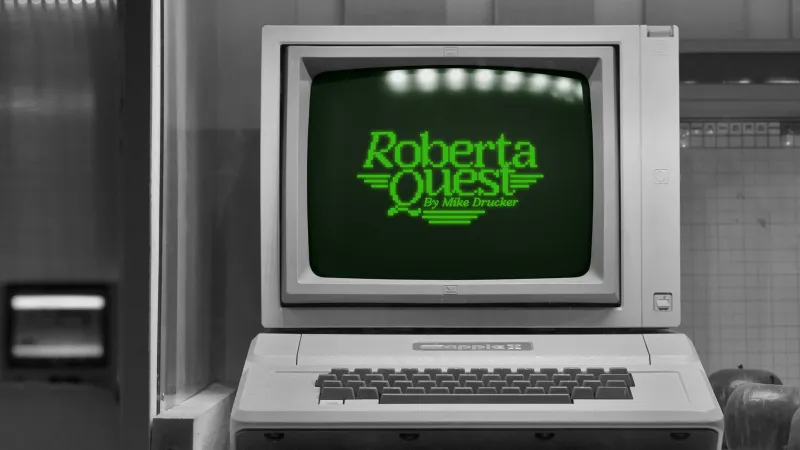
Roberta Williams and her husband Ken Williams were the brains behind Sierra Online, a game studio whose title card music is still stuck in my head over three decades later. While it wasn’t her first game, Roberta Williams is probably best known for King’s Quest. For those who were born after 1995, King’s Quest was a series of early adventure games in which you played King Graham and later members of his family as they went on adventures in and around the fictional fantasy kingdom of Daventry. The game was so successful that it spawned an entire line of Quest games, such as Space Quest and Police Quest. A lot of the adventure DNA in games today started in Roberta Williams’ head.
For years, King’s Quest was one of the best-selling computer game franchises of all time. It was also an ongoing technological marvel, pushing the limits of then-stunning innovations like soundcards and CD-ROM drives. And keep in mind this is a period of time when each new computer was leagues ahead of the last in terms of processing power, memory, and, hell, the amount of colors you could have on screen. King’s Quest V’s voice acting shut my head down when I was six. The CGI opening of King’s Quest VI might as well have been a feature film for how it dazzled me. It looks like a choppy tech demo now, but in 1992? Toy Story was still three years away, baby!

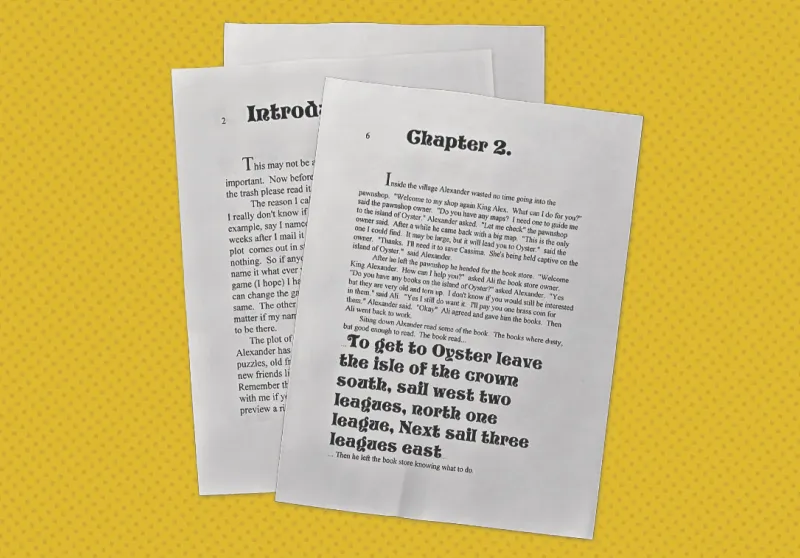
Mike Drucker’s childhood game design document for his own King’s Quest sequel
Here’s how much I loved King’s Quest: When I was ten, I wrote up a full pitch doc for what would then have been King’s Quest VIII. The story was a little thin, but at least my ideas for the game itself were even more nonexistent because I was a child. It was written in multiple typefaces in what was maybe a size 16 font. I sent it to Sierra Online and never heard back because… why would I? It probably went in the crank pile where they stored any letters asking if Princess Rosella was single.
That’s all to say that when Game Informer asked me if I wanted to speak with Roberta Williams and write about our conversations, I was terrified. I’m not a journalist, so this was supposed to be a more personal, casual conversation rather than a straight-up interview. I hadn’t been this nervous to meet a celebrity since I met Weird Al, and while he was super nice, I didn’t want to push my luck with two idols. If Roberta Williams hated me, I probably would’ve given up and none of you would’ve heard from me again and this article would’ve been written in the third person by someone else and involved the words “mysterious tragedy.”
The Roberta Williams Timeline
Screenshots from King’s Quest I, II, and III
The Roberta Williams Timeline
1970s
- 1976 – The original Colossal Cave releases and will influence Roberta Williams’ work
- 1979 – Ken and Roberta Williams get an Apple II computer and found On-Line Systems
1980s
- 1980 – Mystery House, Wizard and Princess
- 1982 – On-Line Systems becomes Sierra On-Line
- 1983 – IBM commissions King’s Quest
- 1985 – King’s Quest II
- 1987 – Mixed Up Mother Goose
- 1988 – King’s Quest IV
1990s
- 1990 – King’s Quest V
- 1992 – King’s Quest VI
- 1992 – Mike Drucker is gifted the terrible King’s Quest V NES port and Christmas is ruined
- 1994 – King’s Quest VII
- 1995 – Phantasmagoria
- 1996 – The Williams sell Sierra On-Line, but Roberta stays involved
- 1998 – Sierra releases Half-Life by new developer Valve
- 1998 – King’s Quest VIII releases, the last entry designed by Roberta Williams
2010s
- 2015 – The Odd Gentleman’s King’s Quest reboot
2020s
- 2020 – King’s Quest is inducted into the World Video Game Hall of Fame; Roberta Williams receives the Pioneer Award at GDC
- 2023 – Roberta Williams’ Colossal Cave 3D releases
You’re Roberta Williams
You’re Roberta Williams
But that’s not what happened. What happened was I got to talk to Roberta Williams three times over the course of a few weeks about everything from her inspirations to her first new game in over two decades, the sublime remake of Colossal Cave. Our conversations totaled almost four hours, which is far more time than I expected, and I’m grateful for every minute. Roberta Williams isn’t just brilliant. She’s sharp and funny and nice and cool in a way that I can only describe as a complete relief. The fact that I’m not a reporter with responsibilities allows me to be extremely biased and emotional here.
At the start of our call, she politely said she liked The Tonight Show, which I’d worked on, and especially the sketch “tight pants,” which I had not. Coincidentally, Jimmy Fallon is actually a huge fan of King’s Quest, something I found out through research and one hundred percent used to my advantage when I interviewed for the job back in the day. When the show transitioned from Late Night to The Tonight Show, they made a now-defunct app full of mini games. I, of course, wrote the script for a short point-and-click adventure parody of King’s Quest.
Roberta takes all this information in politely. “Well, I’m a fan of his as well,” she says. Something that strikes me about her is both a pride in her brilliant work and a slight discomfort in the number of people in my generation who want to vigorously shake her hand and say, “Thank you for your service,” like she was a firefighter during a natural disaster. I really did try my best to tamp it down to a minimum. It really was hard not to just repeat, “You’re Roberta Williams.”
She continued, “Well, I appreciate that. I appreciate that a whole lot. You know, I get that from many people around your age, and I don’t know your age, but I’m assuming around your age.” She was absolutely correct in the assumption about my age.
Meeting Mother Goose

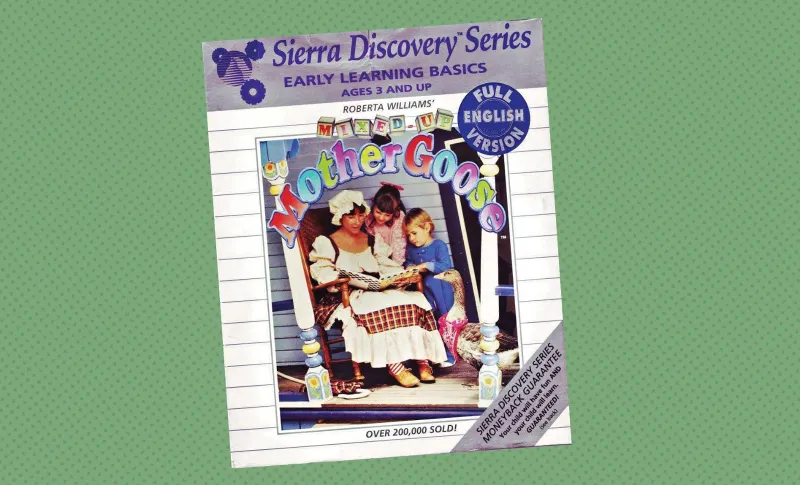
Roberta Williams on the cover of 1987’s Mixed-up Mother Goose
Meeting Mother Goose
Early in our first conversation, I talked about her influence on my generation’s creative life and education. I’m being serious when I say King’s Quest literally helped teach me to read. I asked her how she felt about so many people having that same experience.
“I just sort of thought of it as a game, you know?” she said. “I’m just doing a game, but at the time, you don’t really realize how it might be affecting people, or especially kids. You just don’t really think about that. You just think, you know, this is fun. I wanted to be entertaining. I wanted to sell well. I wanted to, you know, go out there and people appreciate it. Because I was in my 20s, early 30s, and you don’t think like that, ‘like, oh, it’s gonna teach kids to read and it’s gonna teach them another language,’ maybe, if they’re from another country or they’re learning how to solve puzzles. I mean, you kind of do, but not in a big way. But now I really, truly understand it, because I’ve been told so many times, and I’ve come to the point where I almost feel like I’m a mom or a teacher to a lot of kids out there.”
I point out to her that she posed as the title character on the cover of her children’s game, Mixed-Up Mother Goose, and, for a lot of us, she really is Mother Goose. She laughed and agreed and then informed me of something I actually didn’t know: Just how innovative that specific game actually was. Yes, it was for little kids, but it was also Sierra Online’s first CD-ROM game and featured a character creator, an extreme rarity for the time.
“I [thought] little kids are going to want to have it kind of look or feel like them, like themselves. You could pick out if you wanted to be a boy or girl, or even skin color. You could change your hair color. And I mean, you could do a lot, but you could make it be pretty much how you might see it. See yourself right as a little kid, and that was unique.”
She added, “You know, Ken and I were talking about maybe redoing Mixed-Up Mother Goose.” They’re considering bringing it back – or a spiritual successor – for a new generation. The spiritual successor part is because, over the years, with Sierra Online being sold and repackaged, Roberta and Ken lost the rights to games like King’s Quest or her original hit, Mystery House. In the world of IPs, corporate buyouts and mergers and spin-offs can make it extremely murky exactly who owns the rights to something. And, to a perfectionist like Roberta who has the receipts to back it up, having to work under someone else on a franchise she created wasn’t happening.
“There’s no way that I could do, like, a Laura Bow [mystery game]. I could probably go to Microsoft and say, ‘Well, you know, I’ll partner with you and do [King’s Quest],’ but I don’t want to do that. And they would probably be thrilled, but I just don’t want to do that.”
Fantasy Adventures
Screenshot from Roberta Williams’ 2023 remake of Colossal Cave
Fantasy Adventures
Since we were talking about childhood, I mentioned that the King’s Quest games always reminded me of going to Disney World as a kid, with its various fantasy themes and areas. I grew up in Florida and my aunt was a baker at one of the hotels, so we sometimes got free tickets and went a few times a year. To me, Prince Alexander traversing the Land of the Green Isles in King’s Quest VI felt the same as moving from the different zones of the Magic Kingdom.
Roberta lit up at this. “I loved Disneyland when I was a kid. I grew up in Southern California, so we went there quite a lot, and it wasn’t as expensive as now, so my parents could kind of afford it, but I just loved it. And one of the things I loved was the different lands, like Adventureland and Tomorrowland, because they all were different. But they were all done in a fantasy way, an almost cartoony way. And all of those were obviously for kids, arranged for kids to just use their imagination to be in those worlds. And they all seem to come together, you know? I love Disneyland, because I just felt like I was in this fantasy, magical world of storytelling all around me.”
God, I love this person. Can you see why I love this person?
“So I can tell you, Disneyland really affected me a lot, along with fairy tale books and books on myths. I always liked the Greek myths and legends. Things like Dracula or King Arthur. I used to like to dream and wonder, ‘Did they really exist?’ And unfortunately, I didn’t have the internet to look it all up, right? And so it just stayed in my imagination, because I couldn’t look up anything that said they weren’t real. So as far as I was concerned, they were.”
Perhaps it’s a cliche to see yourself in an artist you respect to an unhealthy degree, but I saw a lot of myself in that statement. The imagination of childhood, where if you closed your eyes just right and turned your head just a little, you could make anything real. And make no mistake, I felt the same way about King Graham and Daventry that she felt about Greek myths. As far as I was concerned, they existed somewhere, and we were just getting a glimpse of their story.
Adventures In Text

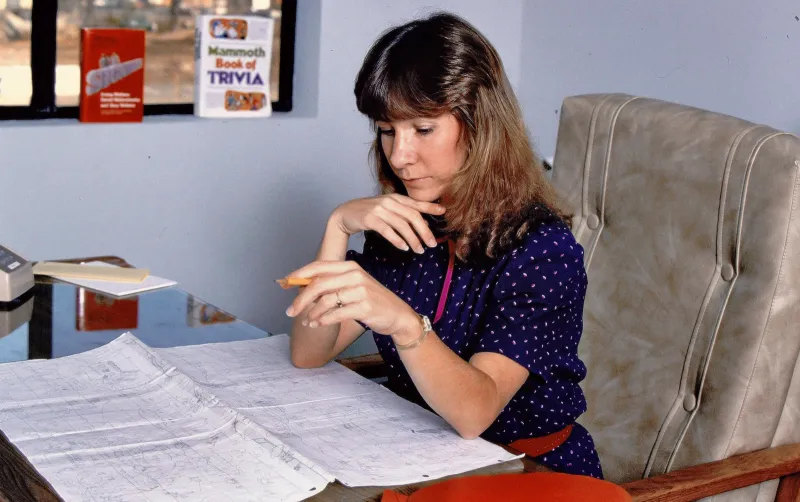
Adventures In Text
But perhaps the biggest inspiration for Roberta Williams was Colossal Cave, a text adventure from the early days of computing. It’s the game she recently remade and one that I recommend playing in virtual reality because, lord almighty, it nails that theme park vibe.
“Colossal Cave is what got me into the business. And at the time I was just, you know, 24 years old and we just had our second child. I actually [had] some jobs, one in a junior college and one for the county of Los Angeles as an IBM 360 computer operator, which, as it turns out, is a really easy job. Computers are not that hard, and so I’ve done those kinds of things, but it had nothing to do with imagination. And so I was trying to figure out what I wanted to do with my life. I didn’t want to program, even though Ken and I were making good money with programming.”
It was then, through the then-small computer community, she found Adventure by William Crowther, a programmer and cave diving enthusiast who based the game on his spelunking at Mammoth Cave in Kentucky, but with, you know…more magic and dwarves and whatnot. This game bounced around, got added to, ripped off, copied, ported, re-ported, and was later renamed Colossal Cave Adventure. Playing this game on the family’s Apple II is what finally gave Roberta an outlet for her imagination.
“I told Ken, ‘I’m gonna write a game,’ and he was like, ‘Okay, yeah, little girl, like, go ahead. I’m working on a big boy business.’ And so I did. I started out with the idea, big pieces of white construction paper where I could just doodle and draw circles and put in ideas and arrows and look going this way and that way, and I just started doing that with the idea of an Agatha Christie-type story mixed with the game Clue, and that became Mystery House.”

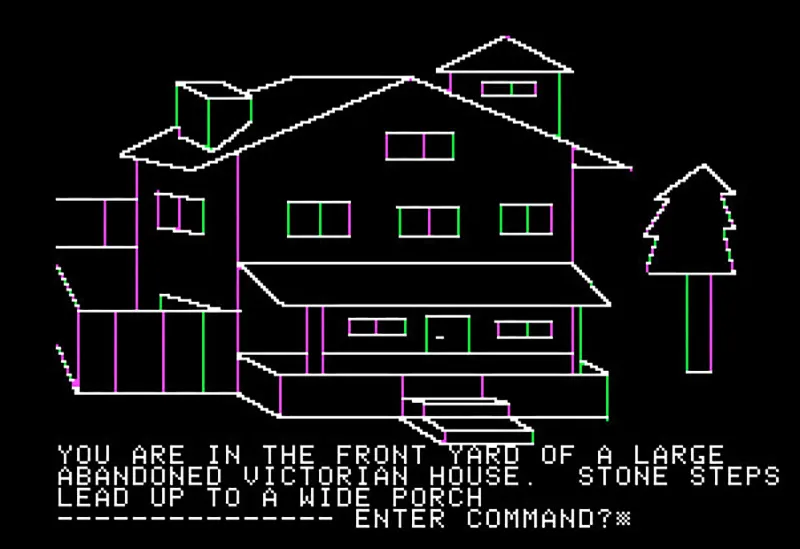
Mystery House (1980)
Mystery House was a hit and the first graphical adventure game to boot. And even with that success, King’s Quest itself almost didn’t happen. While the game was still in development, venture capitalists got involved and forced the company to refocus its development resources to cartridge-based consoles… right as that side of the industry was collapsing. If you want to read about Roberta Williams intentionally and hilariously blowing up the meeting to sell their company, check out Ken Williams’ book, Not All Fairy Tales Have Happy Endings.
“I felt very confident that King’s Quest was going to be big. I did. And I don’t want to come across as if I thought it was a Miss Smarty Pants, too-big-for-my-britches kind of thing. But I did feel like this was going to be a big deal, and there was no way I was going to give that over.” The game was instantly a hit. Their studio, which had to lay off a hundred employees due to the business downturn, was suddenly able to hire back nearly everyone and more.
No, You Hang Up
No, You Hang Up
Our conversations circled around and back. I mentioned my elementary school pitch doc maybe three times, probably to our mutual embarrassment. I asked if she was involved in the King’s Quest novels (she wasn’t and didn’t love the changes to the lore). I asked how she felt about being one of the first big gaming celebrities (marketing sold her on the idea of putting her name on the box, but she worried it wasn’t fair to the rest of the team). I asked her about the brutal murders in Phantasmagoria (she wrote who would die, but the art director Andy Hoyos would consistently shock her with creative ways how they died).
I’m someone who hates being on the phone, and I requested more hour-long calls where I got to say, “That’s awesome,” and, “That’s so cool,” on repeat like the tape in Ferris Bueller’s bedroom, which is an era-appropriate reference. To me, she is Walt Disney and Steven Spielberg combined, and I wanted to enjoy every minute. And fortunately, Roberta didn’t mind that forest of red flags. She loves that people still love and imitate her games, some of which were released before her fans were even born. She says it still gives her a “lump in my throat.”
At the end of one call, she said, “I enjoy it. And I want to keep people playing our games, even if they’re old. There’s a little bit of a legacy, you know, so I think it’s fun to do.” I said it was amazing to meet her, and I was honored to talk to her and, sadly, I thought I had enough for the piece. But if I needed to talk more, I meekly said I might ask for another call.
“Yeah, we probably will be talking again,” she chuckled before hanging up. “I’m betting probably. Alright, well, see you later.”

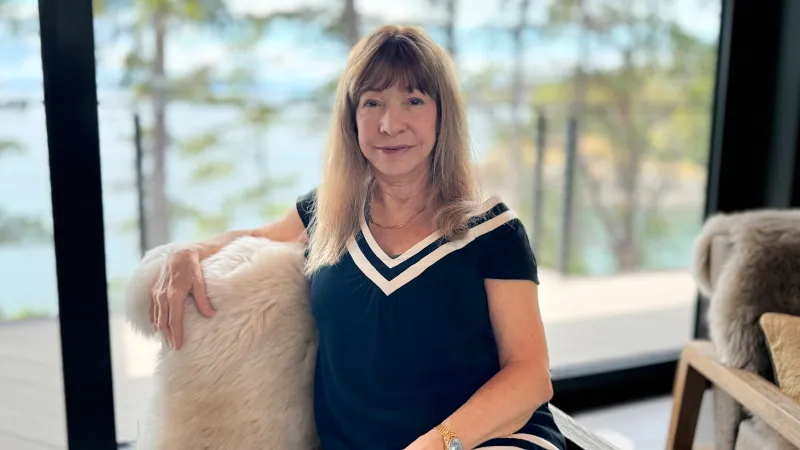
Mike Drucker is a television writer and producer, known for Mystery Science Theater 3000, Full Frontal with Samantha Bee, and The Tonight Show Starring Jimmy Fallon. He also worked for Nintendo as a localization writer on games like Zelda: Skyward Sword and Kid Icarus: Uprising. His book, Good Game, No Rematch, is available now.