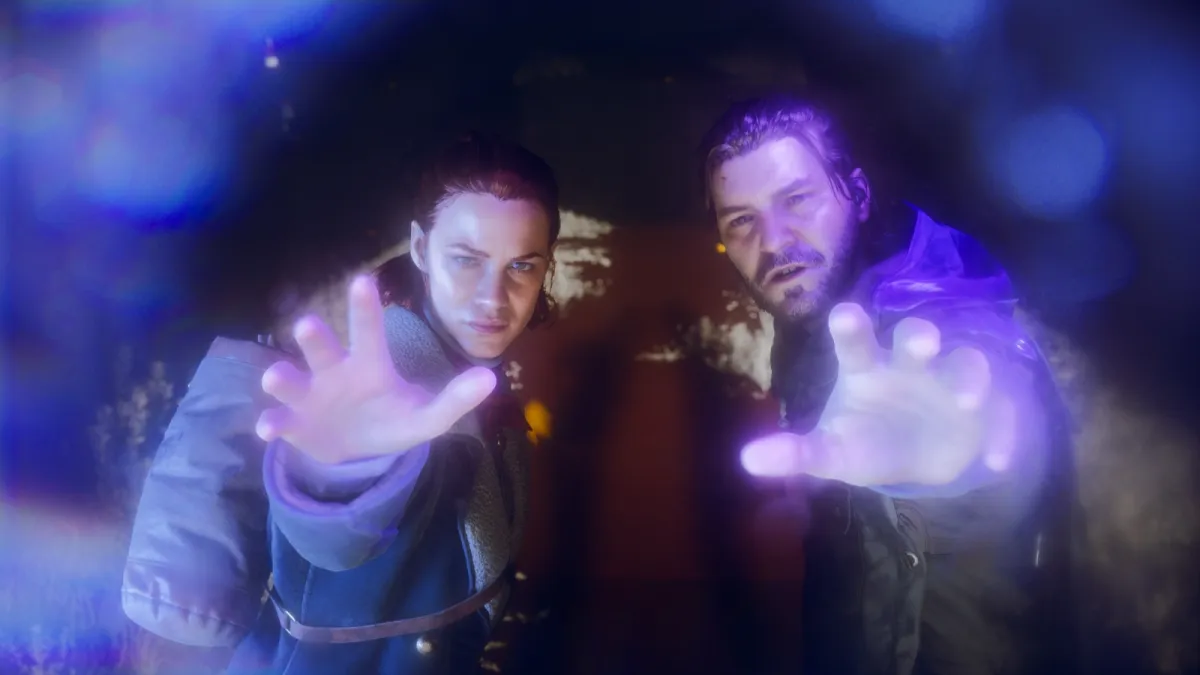

Please allow the first sentence here to warn you that this interview discusses a portion of Control Resonant that takes place near the end of the game and is arguably the most unexpected and surprising sequence. I encourage you to experience it without spoilers. So if you haven’t beaten the game yet, please do, and then come back to this page.
However, if you have beaten the game, or curiosity has driven you to learn what game has been redacted from the headline and why (it’s the 1995 Super Nintendo RPG, EarthBound, by the way), then please read on.
FULL SPOILERS AHEAD
In the late-game of Control Resonant – basically right before you tackle the final confrontation – the game suddenly shifts timeframe and genre to become a 16-bit RPG. The nostalgic lens turns the game into something that feels like 1995’s EarthBound, complete with turn-based battles, in order to explain the trauma that Jesse and Dylan went through at a young age after they came across an object of power: the slide projector. The whole sequence is funny, heartbreaking, weird, and importantly effective at making you feel you are seeing a part of their past. It was particularly effective on me as I have fond memories of playing EarthBound and games like it when I was young. To see and experience Dylan and Jesse’s childhood this way felt accurate, as absurd as that sounds.
I reached out to Remedy to specifically discuss that portion of the game. You can find the full e-mail interview below with the team members who contributed to its creation.
The big RPG backstory sequence for Jesse and Dylan – why approach the storytelling that way?
Lead level designer, Anne-Marie Grönroos: The basis for the whole sequence is that the Hedron attacks Dylan’s mind, breaks his reality apart, and he has to rebuild himself. We wanted the reality-breaking part to affect the game itself and have the player feel some of the confusion Dylan is feeling by breaking the fourth wall.
Who pitched that sequence, how did they pitch it, and was it difficult to sell to the larger team?
Grönroos: At Remedy, ideas rarely come from a single person or team, and we rarely do formal pitches, but rather discuss and workshop ideas cross-craft until they start taking the shape of something we like. The initial idea from the writer was for this to be a text-based adventure, to return to a very early form of a video game to show that the Patterning is devolving him, but an Alan Wake 2 DLC had already done that, and we wanted to find something else.
Independently, some months ago a level designer had suggested a sidequest with JRPG pixel graphics, but that had gone nowhere. I remembered that and suggested doing an old Final Fantasy-style JRPG here, which also felt more fitting since that’s the type of game Dylan and Jesse would have played in their childhood, and not a text-based adventure. People got excited about that, and after some concerns about feasibility, we went forth with it. It helped that the level designer who had originally wanted to do the JRPG side quest is a big fan of these types of games and has made them before. I wouldn’t have dropped something this crazy on someone who wasn’t passionate about it and ready to figure out how to do it with our engine that’s not built for anything like this.

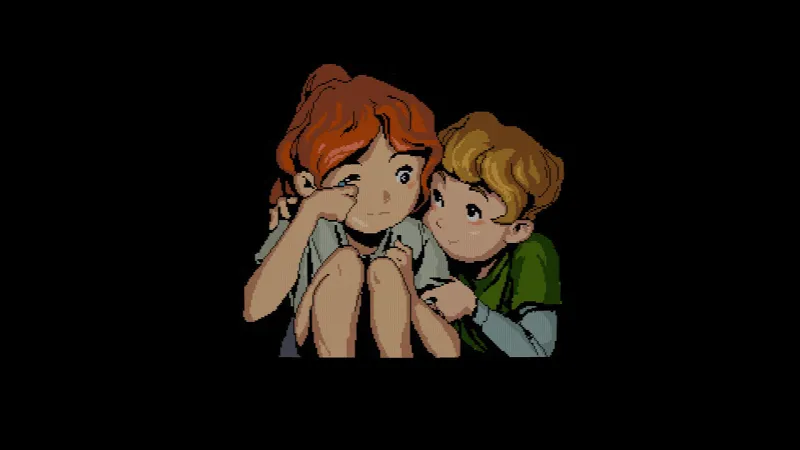
Young Jesse and Dylan as they appear in the sequence
Is EarthBound (Mother in Japan) the primary inspiration for that sequence? Are there big fans of those games at Remedy?
Senior level designer in charge of the JRPG quest, Arhi Makkonen:
The whole Quest was born from that childhood feeling I had when playing old JRPGs – Final Fantasy, Breath of Fire, Chrono Trigger, Secret of Mana, Bahamut Lagoon, and yes, Mother. The most important thing for me was capturing that feeling of a time when games felt like magic. I think many people can relate to that nostalgia, and now Jesse and Dylan share that feeling in the game.
Visually, Mother was a major inspiration of course. Juuso Anttila is the concept artist who did all the splendid pixel art for Rebuild quest. Mother’s style fits the mysterious Americana small town vibe perfectly. We also couldn’t pass up the pun about a story revolving around “Not-Mother” that was made in the style of Mother.
Was it difficult to implement the sequence into the game? Did Remedy’s Northlight Engine need significant work to account for the sequence?
Makkonen: The Northlight engine was designed to work perfectly for third-person action games. Well, Rebuild Quest is pretty much the opposite of that. Northlight is a specialized tool rather than a general-purpose one, so we had to come up with some rather creative solutions to create a 2D JRPG.
First of all, we’re faking the 2D look. In reality, the entire JRPG Ordinary exists within a 3D world that the camera simply views from directly overhead. It occupies a tiny patch in a remote corner of the game world—a space where 3D Dylan would barely have room to stand. The entire game-within-a-game is written in Lua; our incredibly versatile game designer, Tommi Saalasti, created the underlying system, upon which I was then able to build the story.
Since we didn’t really have the tools to create a game like this, I had to hand-code every single detail. Dylan takes one step up, Dylan turns left (where Jesse hopefully is at that moment), text box 1, text box 2. The Lua script for the Rebuild quest alone probably contains as many lines of code as all the other quests in the game combined. And then there were things like animations were restricted to a maximum of two frames, and some UI elements were created using static particle effects.
So yes, we faced all sorts of challenges and compromises, but at the heart of it all was a wonderful story – simply told in a somewhat unconventional way. We trusted that the narrative would make up for some of the imperfections.
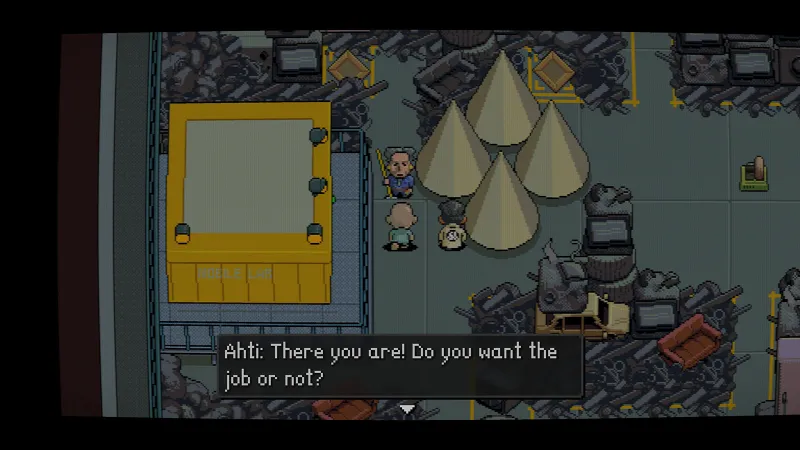
Everyone’s favorite FBC janitor Ahti has a cameo appearance in the sequence
Remedy has a reputation for big unexpected and often crazy singular moments. What are the conversations like around delivering those? In pre-production, are there conversations like, “What is the big moment for this one?” Or do they happen pretty naturally?
Grönroos: They both happen naturally and we also have conversations about what the big moments should be. Sometimes we like a section so much that we decide to put even more resources and importance to it, even if it wasn’t supposed to be all that important from the get-go. The Into the Sinkhole quest, for instance, is a quest that wasn’t planned to be a “tentpole moment” from the start, but we kept putting more effort into it when it was shaping up to be something very special.
But most setpieces in the game were planned to be such from the early stages of pre-production. In Resonant, we wanted to have multiple standout moments instead of a single sequence like the Ashtray Maze overshadowing everything else, and I’m happy to see that players have different favorites.
And a different approach from Control is that several of these memorable moments (Sinkhole, Underpass Fault, the JRPG section) are more emotional and subdued instead of bombastic action (although we also have big action setpieces), which was an interesting challenge itself.
Was there a fear that the visuals would limit the emotional impact of the sequence?
Grönroos: Yes, but we decided to trust the writing. Several other games have managed to deliver a similar emotional impact despite pixel graphics (and sometimes because of them, since the level [of] abstraction can make characters more relatable and up to the player’s interpretation), so we weren’t too concerned.
Was there a fear that action game fans would be frustrated by the RPG sequence?
Grönroos: Yes, this was the main concern about the sequence. It was a very polarizing sequence in the playtests: people either loved or hated it. We did discuss shortening it significantly, but in the end decided to keep it as it is but added some fast travel options and make some parts skippable. There were more fans than haters, and we didn’t want to sacrifice something we really enjoyed.
How concerned were you about the actual RPG mechanics of that sequence?
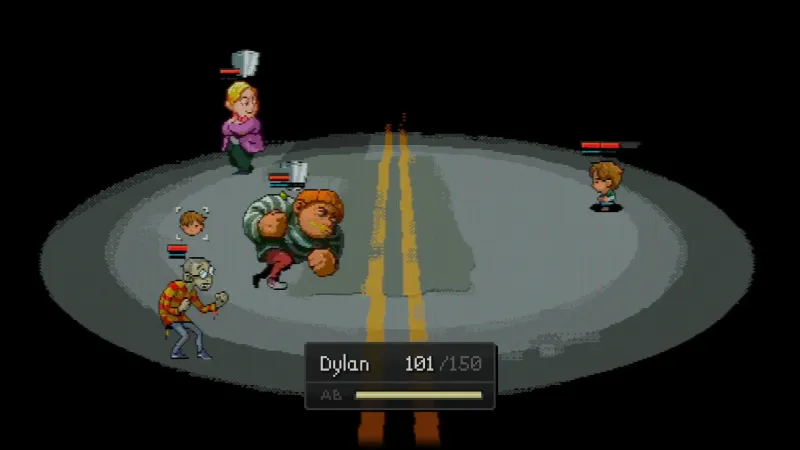
Makkonen: Since Rebuild doesn’t feature a vast number of battles, we didn’t need to build particularly deep RPG or progression systems. The combat served as an additional storytelling tool – illustrating how bullies torment Dylan, showing his first fight (against rats, naturally), and depicting his eventual abduction by the FBC.
Refining the combat to be simple, yet offer the player meaningful choices required a few iterations. In addition to standard attacks, the children can occasionally use special abilities: Dylan delivers a heavy blow to a single enemy, while Jesse fires at everyone. Enemies deal enough damage that defending becomes necessary when multiple foes target the same character.
The lightbulbs in The Underpass mission goes in similarly unexpected, animated directions. How did that mission come about? What was the pitch like for that one?
Grönroos: That one started with the idea of doing something comically mundane, switching lightbulbs, and adding a paranatural twist to it. The cartoon man wasn’t in the initial version, but instead we were going to do live action videos and have Dylan get stuck in that video as the end twist. They were supposed to be old-fashioned “work safety” videos explaining how to change lightbulbs, and as the quest went on, it became more and more obvious that the maintenance guy in the videos was too aware of what Dylan was doing. This all came out from a one-hour workshop.
There wasn’t really a pitch, but rather a back-and-forth like “could we do a quest about Dylan changing lightbulbs in a ritualistic way? We could have these sentient work safety videos explain how to do it and “Dylan could get trapped inside the video.” Much later, when the live action turned out to be a no-go, we pivoted to the current cartoon instead, and that was even funnier than our initial idea.
To read Game Informer‘s review of Control Resonant, follow the link.