






You’ve made up your mind to spend top dollar on a book-style foldable that provides you with a big-screen experience but folds in half when you want to carry it around. Sounds fantastic, right? Well, here’s something worth sitting with: the Galaxy Z Fold 7 (256GB), from July 2025, still retails for $1,999, while the just-announced Moto Razr Fold (512GB) costs $1,899.
How did Motorola do that? Did it make any compromises in undercutting the Fold 7 by $100 and still offering twice the storage? Well, there are a couple of papercuts that might not sit well with you, particularly if you base your buying decision on the spec sheet. A better approach, in my opinion, is to look past that and focus on how you’ll actually use the device.
I’m not writing this comparison to declare a winner based on the specifications, but with an intent to help you figure out whether Motorola’s first crack at the book-fold format is worth trusting with your money, or whether the Galaxy Z Fold 7, despite its age, still holds its ground in 2026 and suits you better.
Razr Fold vs. Samsung Galaxy Z Fold 7: Specifications at a glance
| Razr Fold 2026 | Galaxy Z Fold 7 | Difference | |
| Price | $1,899 (16GB/512GB) | $1,999 (12GB/256GB) | $100 cheaper at base, $300 cheaper for equivalent storage variant |
| Dimensions | Unfolded: 144.47 × 160.05 × 4.7mm Folded: 160.05 × 73.6 × 10.04mm 243g |
Unfolded: 158.2 × 143 × 4.2mm Folded: 168.4 × 72.6 × 8.9mm 215g |
Z Fold 7 is 28g lighter and 1.14mm thinner folded |
| Inner display | 8.1″ LTPO AMOLED, 120Hz, 6,200 nits, HDR10+ | 8.0″ Dynamic LTPO AMOLED 2X, 120Hz, 2,600 nits, 368ppi | +3,600 nits peak brightness |
| Cover display | 6.6″ LTPO pOLED, 165Hz, 6,000 nits, GGC3 | 6.5″ Dynamic LTPO AMOLED 2X, 120Hz, 21:9 ratio, GGC2 | Brighter and faster refresh |
| Processor | Snapdragon 8 Gen 5 (3nm) | Snapdragon 8 Elite for Galaxy (3nm) | Newer but slightly slower chip |
| RAM / Storage | 16GB / 512GB — all variants | 12GB / 256GB and 512GB; 16GB on 1TB only | More RAM at the equivalent storage variant |
| Main camera | 50MP (f/1.6), Sony LYTIA 828, OIS | 200MP (f/1.7), ISOCELL HP2, OIS | Lower resolution sensor |
| Ultrawide | 50MP (f/2.0), 122°, Macro Vision, Sony LYTIA | 12MP (f/2.2), 120°, autofocus | Fold: higher resolution; Z Fold 7: autofocus |
| Telephoto | 50MP (f/2.4), 3x optical, Sony LYTIA | 10MP (f/2.4), 3x optical | Significantly higher resolution |
| Cover selfie | 32MP (f/2.0), punch-hole | 10MP (f/2.2), punch-hole | Higher resolution, wider aperture |
| Inner selfie | 20MP (f/2.0), punch-hole | 10MP (f/2.2), punch-hole | Higher resolution |
| Battery | 6,000mAh silicon-carbon | 4,400mAh Li-Polymer | Bigger battery |
| Wired charging | 80W wired, 50W wireless, 5W reverse | 25W wired, 15W wireless, 4.5W reverse | Faster wired and wireless charging |
| Stylus | Moto Pen Ultra ($99 extra) | No S Pen (dropped after Z Fold 5) | Stylus support available |
| Cover glass | Gorilla Glass Ceramic 3 | Gorilla Glass Ceramic 2 | Stronger glass |
| Water resistance | IP48 + IP49 | IP48 only | Adds high-pressure jet resistance |
| Software | Stock Android 16 + Moto AI | One UI 8, Android 16 | Both offer seven generations of software updates |
Writer’s note: The Galaxy Z Fold 8 is expected to arrive in late July 2026. If you’re still leaning toward the Fold 7 by the end of this comparison, I’d suggest you wait two months to see what the Fold 8 offers and then make a decision. For now, the Razr Fold already undercuts the Fold 7 by $300 for the same storage tier, and that gap might increase once the Fold 8 arrives.
Price and availability

The Razr Fold (unlocked, 16GB + 512GB) will be available from May 21, 2026, at $1,899, via the company’s official website and Best Buy. Carrier financing isn’t on the table just yet, though it will follow in the coming months.
The Galaxy Z Fold 7 has been on carrier shelves since July 2025, still retailing for $1,999 for the baseline variant with 256GB of storage. The mid-cycle price hike now puts the 512GB variant at $2,199 and the 1TB variant at $2,499.
With the hike in place, the Fold 7’s 512GB variant asks $300 more than the Razr Fold.
| Razr Fold 2026 | Galaxy Z Fold 7 | |
| Price (base) | $1,899 — 16GB/512GB | $1,999 — 12GB/256GB |
| On sale | May 21, 2026 | July 25, 2025 |
| Where to buy | Motorola.com, Best Buy (unlocked) | All major carriers + unlocked |
| Carrier retail | T-Mobile, Verizon, Xfinity Mobile (coming soon) | AT&T, T-Mobile, Verizon — now |
Fold 7 comes with generations of refinement
The Fold 7 is the thinnest and the lightest book-style foldable the company has ever made, and I felt that the moment I picked up the device. At just 215 grams and 8.9mm folded, it doesn’t feel much different from a conventional slab phone.
The Razr Fold, on the other hand, doesn’t feel quite as sophisticated. At 243 grams and 10.04 mm folded, it’s noticeably heavier (28 grams) and thicker than the Fold 7. The difference isn’t catastrophic, I’d say, but you’d notice it over the day.
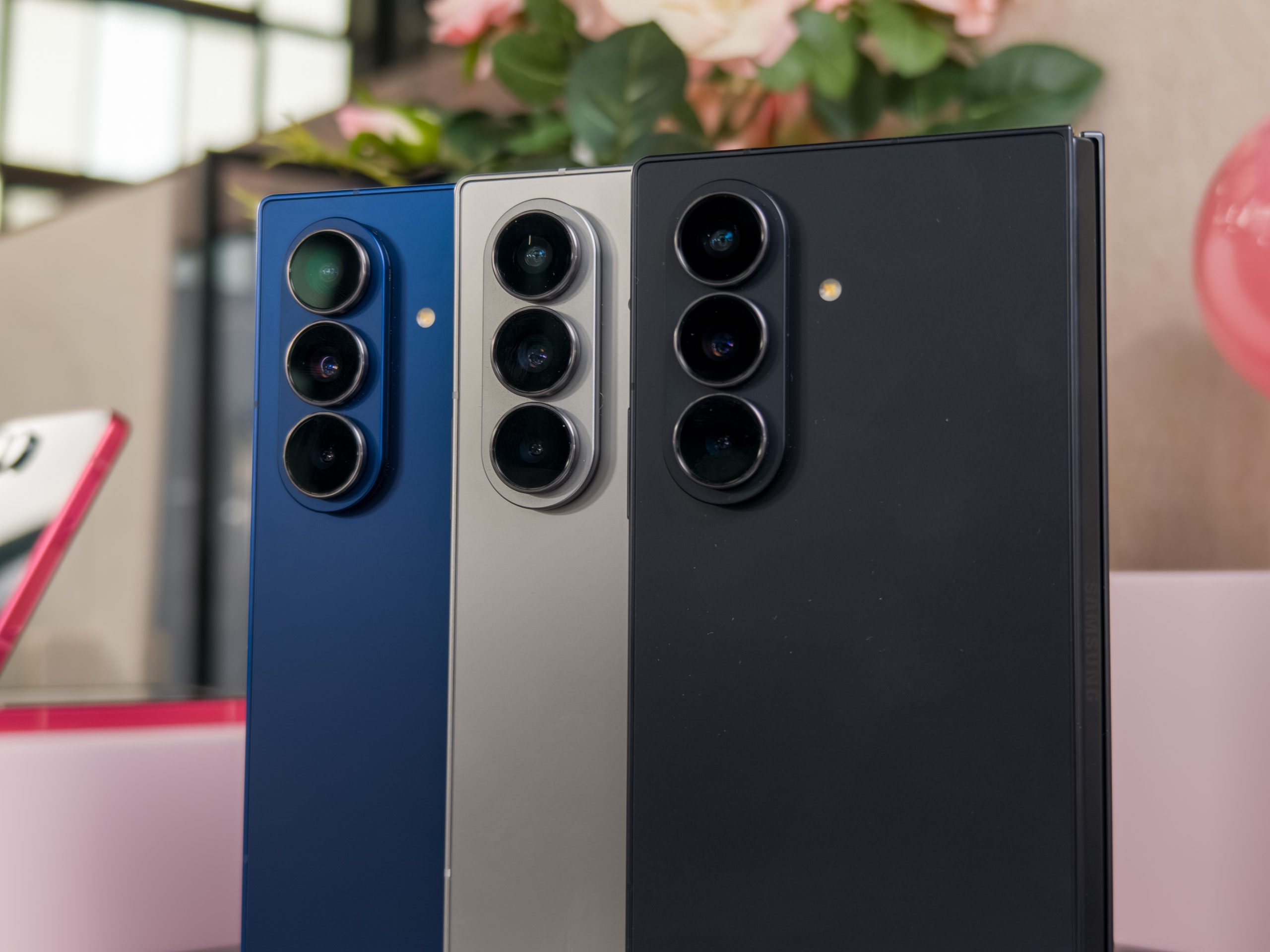
Several early hands-on reviews suggest that the Razr Fold has a smooth stainless steel hinge, a minimal inner crease, and a camera island that’s wide enough that the phone sits flat on a table. While the Fold 7 has its hinge and the crease sorted, the tabletop wobble is still there.
The Pantone colorways on Motorola’s foldable — Blackened Blue and Lily White — come with a grippy, fingerprint-resistant, and warm feel in hand. The Fold 7 ships in a total of six color options, all with the classic glass-and-aluminum approach. Further, the Razr Fold’s IP49 edges out Fold 7’s IP48 ingress protection rating.
The brightness gap between the Razr Fold and the Fold 7 is real
The Razr Fold outshines the Fold 7 in one key aspect: peak brightness. If you live somewhere with punishing afternoon sun and have to step outside frequently with your phone, Motorola’s numbers are higher than any other foldable on the market.

Even otherwise, watching content on the Razr Fold’s screen should be a better experience, as higher peak brightness brings along better highlights during HDR playback. And yes, the inner screen is about 10% sharper (based on the pixels per inch).
Even though both feature 120Hz LTPO inner panels, the Razr’s cover screen can go up to 165Hz, compared to the Fold 7’s 120Hz, meaning the screen you’ll interact with most is smoother on the Razr Fold. Motorola’s hinge has also gathered some early praise about how solid it feels and the way it keeps the crease minimal.
Snapdragon 8 Gen 5 vs. Snapdragon 8 Elite: It’s a tie for everyday users
To put it simply: the Razr Fold has a newer engine in the Snapdragon 8 Gen 5, but the Z Fold 7’s older Snapdragon 8 Elite for Galaxy is tuned better and wins on raw performance. I’d still say that both phones should feel virtually identical for most things you throw at them.

For everyday usage, which includes scrolling, messaging, multitasking, and streaming content from OTT platforms, both phones are virtually indistinguishable. You shouldn’t notice a difference in the day-to-day performance, unless you’re gaming for hours, exporting 4K videos, or pushing the on-device AI hard, and that’s barely five to 10% of an average user’s smartphone usage, unless you’re a creator or a media professional.
One thing the Razr Fold gets right is keeping it simple: one configuration only: 16GB of RAM and 512GB of storage, no decisions required whatsoever. That’s a couple more apps active in the background compared to the Z Fold 7’s 12GB RAM. The Z Fold 7 only reaches 16GB on its top-tier 1TB variant.
After Google, Motorola matches Samsung’s seven-year software promise
That’s right. Both foldables ship with Android 16 out of the box, and unlike any of its flip-style siblings launched this year, the Razr Fold gets seven years of OS and security updates, which puts it on equal footing with Samsung.
The Razr Fold runs Hello UX, which is clean, uncluttered, and closer to a Pixel than a Samsung, in my opinion. You get a useful taskbar, three-app split-screen, laptop mode, and tent mode with a desk display, along with the Moto AI features and Google’s Gemini integration.

Samsung’s One UI 8 isn’t running short by any means either. Flex Mode, DeX desktop output, app continuity across the hinge, Circle to Search, and Gemini Live integration aren’t gimmicks. Instead, they’re productivity features that users have built real workflows around, refined over seven generations.
By dropping S Pen support on the Z Fold 7, Samsung handed an opening to any foldable maker, and Motorola took it. The Razr Fold supports the Moto Pen Ultra ($99 extra), with 4,096 pressure levels and palm rejection across both displays.
It’s Samsung’s 200MP camera versus Motorola’s triple 50MP array
Setting aside the fact that the Razr Fold holds the highest DXOMARK camera score of any foldable phone (164 points vs. the Fold 7’s 145), the smartphone has a genuinely impressive camera setup at your disposal.
On the Fold 7, it’s the 200MP (f/1.7, 1/1.3”, OIS) primary sensor that does most of the heavy lifting, while the Razr Fold has a 50MP (f/1.6, 1/1.28”, OIS) wide camera. However, if we zoom past the headline numbers, Motorola’s book-fold actually has better zoom and ultrawide cameras.

The 50MP zoom camera features a larger sensor than the 10MP zoom camera on the Fold 7. Even the 50MP ultrawide camera has a bigger aperture and a wider field of view. The selfie cameras, both on the inner screen (20MP vs. 10MP) and cover screen (32MP vs. 10MP), have more pixels as well.
Despite the 8 Elite chip, the Fold 7 can’t go beyond 4K 60fps video, while the Razr Fold can shoot 4K 120fps for those magical slow-motion shots. Both phones can record 8K videos at 30fps.
Razr Fold offers the largest battery among book-style foldables
I’m talking about the book-style foldables available in the United States. The Razr Fold’s 6,000 mAh silicon-carbon battery is larger than the Fold 7 and the Pixel 10 Pro Fold.
Paired with the Snapdragon 8 Gen 5 (3nm) chip, the foldable should provide around eight to nine hours of screen-on time under mixed usage; that’s what I speculate based on all the specifications.

The 4,400 mAh on the Fold 7, in my experience, delivers around six to seven hours of screen-on time, which isn’t bad for the battery capacity, but can fall short as someone’s primary smartphone, especially if you’re on your phone all day.
Charging speed is the same story. The Razr Fold supports 80W of wired charging and 50W wireless, numbers that the Fold 7 simply can’t match. It’s worth flagging that the Motorola foldable requires a proprietary wireless charger for the full 50W speed, and it hasn’t been released yet.
Bottom line: Is the Razr Fold actually worth your money?
| Razr Fold 2026 | Galaxy Z Fold 7 | |
| Buy it if | You want the brightest foldable display available, the best foldable camera system in North America, and the largest battery in any book-fold | You’re already deep in Samsung’s ecosystem, rely on DeX for daily productivity, and want a lighter, thinner device backed by seven generations of proven foldable refinement |
| Skip it if | You’re not comfortable being an early adopter on a first-generation hinge and unproven long-term software maturity | You’re on a budget and don’t want to spend over $2,000 on the 512GB variant of the foldable |
| Best for | Content creators, outdoor users, and battery-focused buyers | Samsung loyalists, productivity-first users, and enterprise buyers who need DeX, One UI’s multitasking maturity, and a thinner daily carry |
| Value verdict | Strong: more hardware for less money, especially at the 512GB tier, where the gap widens to $300 | Weakening: a mid-cycle price hike, an aging launch date, and a successor weeks away make the $1,999 ask increasingly hard to justify |
Well, if you look at the Razr Fold in isolation, it does undercut the Fold 7 in some crucial aspects. It features a brighter display, a better camera array, and a bigger battery that supports faster charging. All of these aren’t just numbers or specifications, but factors that translate into a meaningfully better experience in daily life.

The phone is brighter under harsh sunlight, lets you capture pictures in multiple perspectives without compromising on the resolution, and is less dependent on finding a charger by the evening on a busy day. The Razr Fold is definitely the more impressive phone in terms of hardware, and it also offers more value for your money. However, what it has to prove is longevity: whether the hinge, crease, and the software hold up over time.

The Fold 7, in my opinion, fights back in the experience of actually living with a book-style foldable. It’s 28 grams lighter, over a millimeter thinner, and backed by several generations of software refinement. These aren’t things that show up in a spec sheet, but reveal themselves over weeks of daily use.
If you’re already in the Galaxy ecosystem, perhaps you have a Galaxy Book as your primary workstation, the Galaxy Buds Pro as your wireless earbuds, and a primary Galaxy smartphone. The Galaxy Fold 7 would suit you the best, as Samsung provides plenty of ecosystem features. Considering the Fold 7? I’d suggest you wait for the Fold 8 announcement, expected in July 2026.
