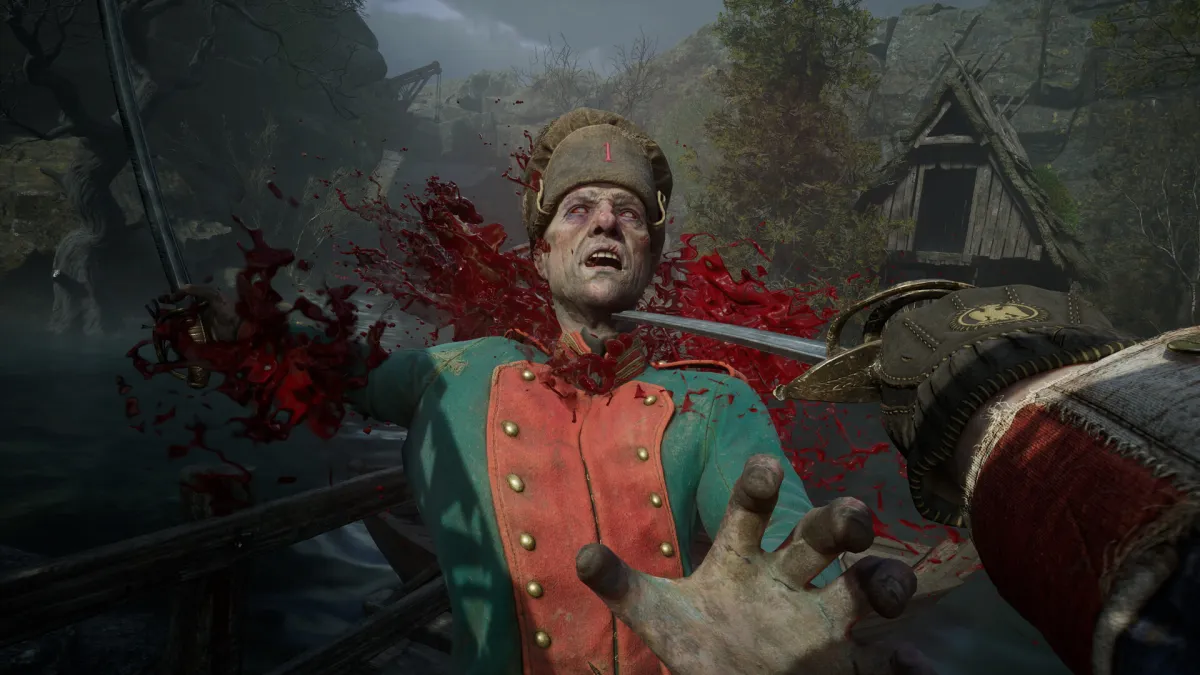




Onimusha: Way of the Sword is the latest game to grace the cover of Game Informer, and you can read my cover story about Capcom’s return to its samurai action series right now. I traveled to Osaka, Japan, to play the game for a few hours and interview the development leads, and one of the more surprising elements of my hands-on time was the lack of puzzle boxes.
A staple of all four Onimusha games – Warlords, Samurai’s Destiny, Demon Siege, and Dawn of Dreams – they were curiously absent from my three hours of hands-on time with Way of the Sword. When I got the chance to talk to director Satoru Nihei about the game, I had to ask if I had missed any. It turns out, I didn’t – there just aren’t any in Way of the Sword.
“As you observed, it’s not really the same kind of puzzle elements we had like usual, like the puzzle boxes,” Nihei tells me. “As you observed, we have puzzle elements in the actual stage, and we’ve introduced those as a way to break up the action.”
What Nihei is talking about there is an environmental puzzle I had to solve about halfway through my demo in Dokyo’s underground lab. Hidden beneath the imperial castle in Kyoto, the evil and demented genma Dokyo is concocting new demonic creations by splicing together Genma, humans, animals, and whatever else she/it can find. This entire stage plays like a classic Japanese ghost house, and I’ll be writing about that in a later feature, but in between the action, I had to pause and solve a puzzle unlike anything in any Onimusha game before.
In a large kabuki theater-like room, there were four masks adorning the wall before me. It was very clear I needed to interact with them, or use them, to advance forward through the stage, but as much as I circled around the room, I couldn’t find any way to do so – no switch, no lever, nothing. So, I left the room.
That’s when I noticed the way light was shining through decorative windows on a wall. Floating ornaments hung in each window, and the patterns of light shining through them matched the masks inside. Specifically, each ornament highlighted a number of holes in the matching mask – one hole to the first mask, two holes to the second mask, and so on. Looking at the ornaments from left to right yielded the solution I needed to interact with the masks inside the room.
I spent longer than I care to admit solving this puzzle. Shizuka, the mysterious woman who either is protagonist Miyamoto Musashi’s Oni Gauntlet, or at least living inside of it somehow, lightly nudged me in the right direction with helpful and polite tips, and I was able to solve it with her help. Don’t worry: Shizuka wasn’t annoying and I didn’t find her tips to be immersion-breaking or anything like that. It’s the kind of help you want a companion to give and hey – if you’re still worried about Shizuka’s help, just be smarter than me when you play the game!
Overall, this puzzle probably took me about five minutes to solve, and then boom, I was right back into the sword action that makes up 90% of Onimusha: Way of the Sword. I enjoy a good environmental puzzle, and this one was quite unique. It doubles as a small break from the combat, too, and that’s by design, according to the game’s director.
“Obviously action is a big focus of the game, but just having action is maybe not so exciting for people,” Nihei says. “So we’ve introduced these puzzle elements into each stage that can get people thinking in between those action sections.”
I’ll be diving deeper into Capcom’s return to Onimusha as part of Game Informer’s month of Way of the Sword coverage. We’ll be publishing exclusive gameplay and behind-the-scenes videos (including a Rapid-Fire Interview) on the Game Informer YouTube channel as well. Keep an eye on the Onimusha: Way of the Sword coverage hub so you don’t miss any of it.
In the meantime, here’s some additional Onimusha: Way of the Sword reading for you:
Are you going to miss the puzzle boxes? Let us know in the comments below!