



Technologist Mag
  • Home
  • Tech News
  • AI
  • Apps
  • Gadgets
  • Gaming
  • Guides
  • Laptops
  • Mobiles
  • Wearables
  • More
    • Web Stories
    • Trending
    • Press Release

Subscribe to Updates

Get the latest tech news and updates directly to your inbox.

What's On
Well… at least God of War Laufey is getting a physical disc

Well… at least God of War Laufey is getting a physical disc

10 July 2026
Designing The Blood Of Dawnwalker’s Combat To Be Immersive

Designing The Blood Of Dawnwalker’s Combat To Be Immersive

10 July 2026
Apple Is Suing OpenAI for Allegedly Stealing Hardware Secrets

Apple Is Suing OpenAI for Allegedly Stealing Hardware Secrets

10 July 2026
Apple is suing OpenAI over theft of trade secrets in blockbuster lawsuit

Apple is suing OpenAI over theft of trade secrets in blockbuster lawsuit

10 July 2026
Sneaking Back Into Dishonored | Replay

Sneaking Back Into Dishonored | Replay

10 July 2026
Facebook X (Twitter) Instagram
Technologist Mag
SUBSCRIBE
  • Home
  • Tech News
  • AI
  • Apps
  • Gadgets
  • Gaming
  • Guides
  • Laptops
  • Mobiles
  • Wearables
  • More
    • Web Stories
    • Trending
    • Press Release
Technologist Mag
Home » Meta’s detection tool fails to identify photos generated by its own Muse Image AI
Tech News

Meta’s detection tool fails to identify photos generated by its own Muse Image AI

By technologistmag.com10 July 20263 Mins Read
Meta’s detection tool fails to identify photos generated by its own Muse Image AI
Share
Facebook Twitter Reddit Telegram Pinterest Email

Earlier this week, Meta announced two new AI products, namely, Muse Image and Muse Video. As the name suggests, these are generative AI tools for making photos and video clips using natural language text prompts. Soon after their rollout commenced, these tools sparked controversy because Meta had automatically opted in Instagram users, allowing others to use their publicly posted media and convert them into remixed AI content. But it appears that Meta courted another loss on its side of the court.

What’s the problem?

Alongside its new AI tools, Meta introduced something called Content Seal, which serves as an invisible watermarking system. Technically, all the images created by the Muse Image AI carry a hidden signal that can be used to identify whether they were made using AI or not. To go with it, the company also launched its own AI identification tool that can read this invisible Content Seal watermark. But it appears that Meta’s AI sniffing tool is not as accurate as the company claims.

According to an analysis by Reuters, images made using the company’s Muse Image AI cannot be reliably detected as AI-generated by Meta’s AI identification software. The outlet analyzed 40 images that were created by Muse Image, but in only 45% of the cases was it able to identify that they were created using AI. In the remaining 55% of the cases, when the images were cropped to one-third or one-fourth of their original size, the AI detection tool developed by Meta simply failed.

Oh, yikes. That’s embarrassing!

That’s a notable flub. On its website, Meta claims that the Content Seal system carries a “hidden provenance signal that stays intact — even when cropped, compressed, resized, or screenshotted.” Following Reuters’ analysis, Meta told the outlet that its AI detection tool is still in preview and that it can’t work reliably when a photo is “heavily cropped.” On an FAQ page available on its AI detector site, Meta also makes it clear that if an image has been generated using a third-party AI product instead of Muse Image, the detection tool will not work.
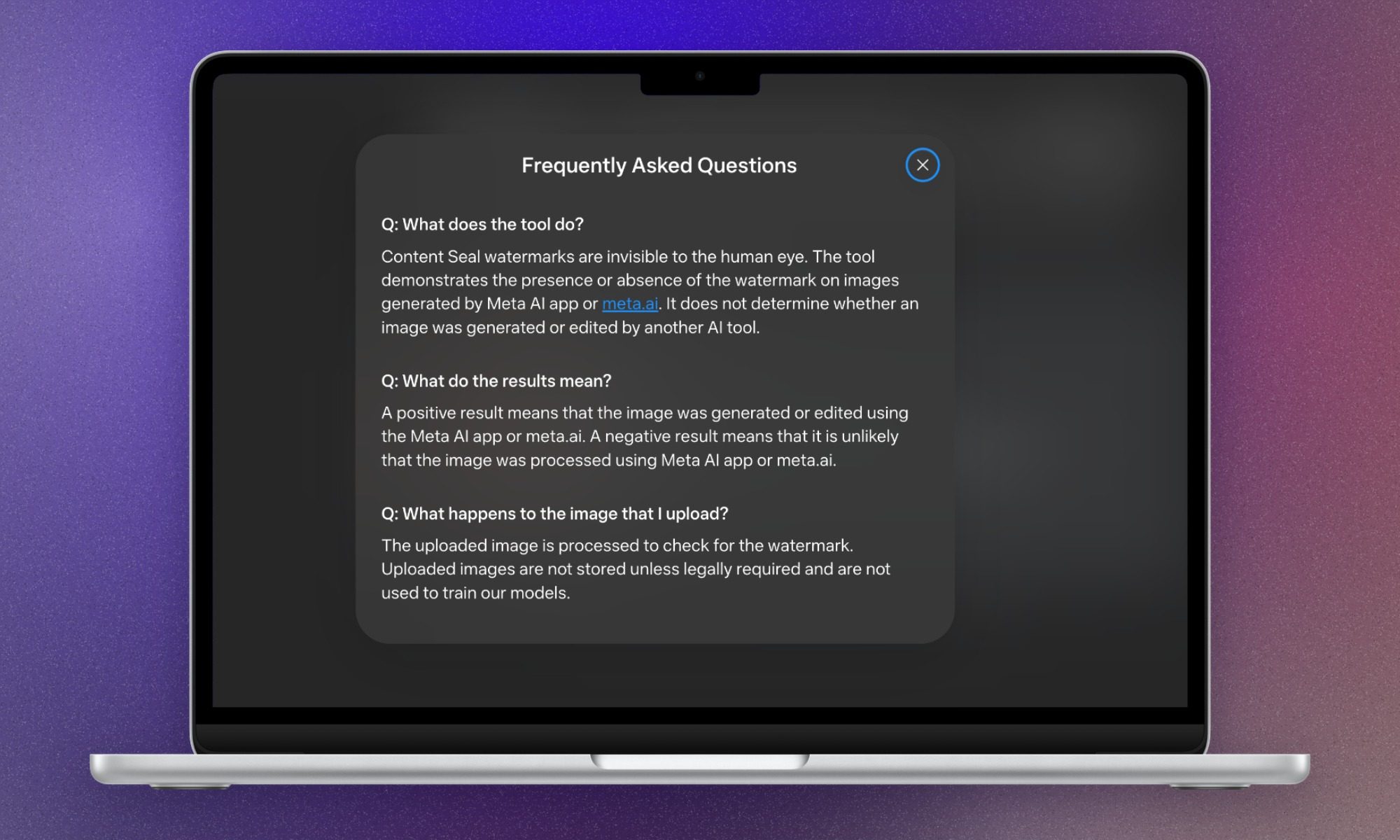
Meta AI identification tool.

Meta won’t be the only AI giant that has created a system like Content Seal. Google already has an AI image detection and watermarking system called SynthID in place. It has been adopted by the likes of OpenAI as well. That means if an image is generated using ChatGPT or Gemini, it carries the invisible SynthID watermark and can be detected using Google’s own AI identification tool, which is now available on Google Search, as well. However, Google also makes it clear that SynthID is not 100% foolproof.

Share. Facebook Twitter Pinterest LinkedIn Telegram Reddit Email
Previous ArticleThe Video Games You Should Play This Weekend – July 10, 2026
Next Article Sneaking Back Into Dishonored | Replay

Related Articles

Well… at least God of War Laufey is getting a physical disc

Well… at least God of War Laufey is getting a physical disc

10 July 2026
Apple Is Suing OpenAI for Allegedly Stealing Hardware Secrets

Apple Is Suing OpenAI for Allegedly Stealing Hardware Secrets

10 July 2026
Apple is suing OpenAI over theft of trade secrets in blockbuster lawsuit

Apple is suing OpenAI over theft of trade secrets in blockbuster lawsuit

10 July 2026
Layla Sleep Coupon: Save Up to 0 in July 2026

Layla Sleep Coupon: Save Up to $600 in July 2026

10 July 2026
Your Google AI Studio apps can finally have polished, presentable web links

Your Google AI Studio apps can finally have polished, presentable web links

10 July 2026
Meet the Battery Startup Taking on China’s Giants

Meet the Battery Startup Taking on China’s Giants

10 July 2026
Stay In Touch
  • Facebook
  • Twitter
  • Pinterest
  • Instagram
  • YouTube
  • Vimeo

Subscribe to Updates

Get the latest tech news and updates directly to your inbox.

Don't Miss
Designing The Blood Of Dawnwalker’s Combat To Be Immersive

Designing The Blood Of Dawnwalker’s Combat To Be Immersive

By technologistmag.com10 July 2026

The Blood of Dawnwalker is a massive role-playing game, and not all of its quandaries…

Apple Is Suing OpenAI for Allegedly Stealing Hardware Secrets

Apple Is Suing OpenAI for Allegedly Stealing Hardware Secrets

10 July 2026
Apple is suing OpenAI over theft of trade secrets in blockbuster lawsuit

Apple is suing OpenAI over theft of trade secrets in blockbuster lawsuit

10 July 2026
Sneaking Back Into Dishonored | Replay

Sneaking Back Into Dishonored | Replay

10 July 2026
Meta’s detection tool fails to identify photos generated by its own Muse Image AI

Meta’s detection tool fails to identify photos generated by its own Muse Image AI

10 July 2026
Technologist Mag
Facebook X (Twitter) Instagram Pinterest
  • Privacy
  • Terms
  • Advertise
  • Contact
© 2026 Technologist Mag. All Rights Reserved.

Type above and press Enter to search. Press Esc to cancel.