The moment one mentions a narrative-driven game, one question springs to the mind of any interested player: Do my choices matter? Video games of all genres are filled with illusory choices meant to make the player feel like they’re impacting the world, even when major moments and mechanics are scripted, and that’s often not a big deal. But in a game like Exodus, a choice-driven RPG that aims to follow in Mass Effect’s footsteps, impactful choices can make or break someone’s experience.
I played a few hours of Exodus at developer Archetype Entertainment’s Austin offices and came away with a good sense of how the studio intends to give players agency. The systems are mostly what you’d expect from a game like this, but there’s one major wrinkle: time dilation. It’s a real scientific principle, and the backbone of Exodus’ worldbuilding. Essentially, the closer you travel to the speed of light, the slower you experience time. As Jun Aslan, Exodus’ protagonist, you’ll embark on multiple lightspeed journeys (fittingly called an Exodus) that last months, years, or decades and only experience a few hours, days, or maybe weeks. However, the people back home on the world of Lidon experience time normally, so when you return, a lot will have changed. Your decisions in Exodus can have major ramifications for civilization down the line, and you must live with the consequences of your actions. It’s a lens that reframes every decision you make.
For example, at the smallest level, you can impact your companions’ opinions of you through dialogue. This is pretty standard for RPGs, with pop-ups in the corner of the screen saying “Salt approves” or “Elise disapproves” based on what you choose to say in conversation with them, or with other NPCs while your companions are nearby. You can also choose which companions to bring with you on each mission, giving you more opportunity to raise or lower their opinion of Jun, the protagonist.

However, time dilation can impact your relationships in major ways. According to narrative director Drew Karpyshyn, “Not every companion will always be with you at all times […] And considering what happens when you’re gone for years and how these relationships may be maintained is a huge part of the game. It doesn’t happen on every mission, but the missions where it does happen – these key Exodus missions that are major points in the story – you have to consider all this.”
I’m not sure what specific scenarios he might be referring to here, but it’s not hard to speculate that there may be decisions where you have to choose which companions to bring with you and which to leave behind. In fact, the damage caused by leaving someone behind like that is the whole pitch of the movie Interstellar, one of Exodus’ major influences. It’s also possible that you don’t get to choose who accompanies you on a journey, and if that’s the case, you’ll be leaving companions on a planet on the path to a future you’ve already shaped.
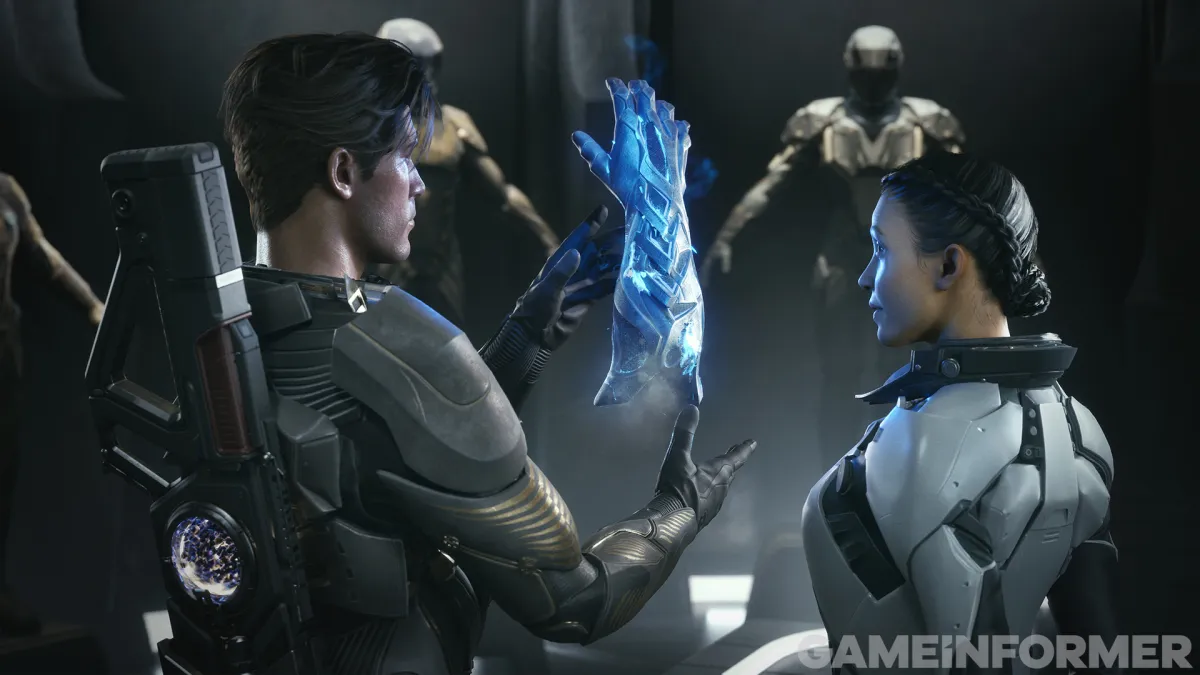
To clarify, many major decisions in Exodus involve Remnants, highly advanced pieces of Celestial technology you’ll encounter on your adventure. In my playtime, I recovered one called the Logos, which is essentially a highly advanced encyclopedia. Lidon, your home, is a planet built on Celestial technology, and Jun has the choice to either lean into the information in the Logos to build on the planet’s foundation or use the Logos to reverse-engineer new tech, making society independent but less advanced.

This is what Archetype refers to as a breakpoint decision. You have to pick one of two significant options, and since Jun has some minor precognitive abilities, you can see abstract glimpses of the future before deciding on one or the other. The option to reject the Celestial tech has an image of some dome-like ships, while the option to embrace it shows a preview of some kind of giant snake. Ostensibly, after picking one, I’ll see the impact of that choice after an Exodus journey. And if I’m leaving a companion behind, they’ll have to live in whichever timeline I’ve committed to.
Jun’s precognitive abilities are best seen in the Dynasty tab in the menu, which has a timeline depicting past events and Lidon’s ultimate fate. In the early hours we played, Lidon is doomed to be consumed by the Rot, which makes sense – it’s the pressure that sets the game in motion. But the screen also shows points earned in three categories, each depicting elements of Lidon’s society: green for culture, blue for science, and red for military. Players will face different story outcomes based on each of these levels, and the previews for breakpoint decisions give you a heads-up on which points you’ll earn for each choice.
All of this is to say that Archetype has injected each breakpoint decision with a lot of variables, and I’m excited about the weight that potentially provides. You’re considering the immediate consequences, the long-term story consequences, how it’ll impact your Dynasty points, and how it might affect your relationships. It’s up to the player to decide which of these factors matter most in the moment, and whether the blowback in other categories might be worth it.
However, while my hands-on time gave me a full picture of the factors involved in making decisions, I never saw the long-term results of one. I understand exactly why – Archetype doesn’t want to spoil its game’s biggest moments months before release – but I can’t fully endorse the story’s malleability without seeing it for myself. The pieces so far are promising, and I’m excited to learn more when Exodus launches on April 7, 2027, on PlayStation 5, Xbox Series X/S, and PC.
For more exclusive details about the game, you can check out my 14-page cover story or check out our other exclusive coverage below.