




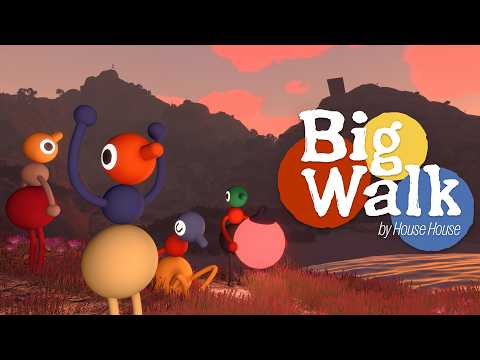
Big Walk developer House House has found itself at the center of a controversy over the upcoming Independent Games Festival on March 3, 2027, after a group of its jurors said they would not vote for any game that has used generative AI in any capacity. The jurors’ statement does not name House House or Big Walk, but the studio eventually updated its FAQ to explain how it used generative AI for coding after IGF discussions. After vaguely posting on social media, those associated with IGF made clear that a sticking point in the voting process was Big Walk.
Former games journalist and game developer Austin Walker posted the IGF jurors’ statement on Bluesky, explaining that voting has been difficult this year due to the “significant increase in the number of submitted games developed with generative AI tools.”
“This has set off some fairly intense discussion and disagreement across the judge and jury pools, and at this point there is no universal consensus on what (if anything) is to be done,” the statement reads. “The IGF has affirmed that we may cast our votes according to our own tastes and values. But we, as a contingent of IGF jurors, feel that this trend and the games embracing it deserve stronger pushback than a vote in silence.”
The statement continues, explaining that not all jurors are on board with the blanket statement, citing reasons including “their ability to safely sign without professional blowback.” It continues, “Above all: Our goal is to state solidarity with those who despair over the future of their art, their craft, and their industry – including those who have experimented with these tools, but who now believe they are not in our best interest.”
The statement continues with the jurors’ beliefs regarding gen-AI, including its negative effects, that any gen-AI used in any process of game development is not okay, noting specifically that “AI-generated code is not an exception to these harms,” and more.
“For those reasons, this year we are declining to vote for any game that uses generative AI in any capacity,” the statement says. “We urge the IGF to adopt a strong anti-AI policy for future years that disallows games containing any AI-generated work.” The statement then includes the names of the IGF jurors who signed it.
Big Walk isn’t specifically mentioned within that statement. However, Kyle LeClair, a four-time IGF judge and a juror for the upcoming IGF, tells Aftermath that “it got to the point where the most-discussed game this year almost entirely involved its AI usage, overshadowing pretty much everything else.” LeClair says it felt like a boiling point, adding, “Anyhow, strong props to the jurors for taking this stance and putting out this letter as well, even if some people believe that using AI for coding purposes is a more gray area, we’re at a point where the amount of AI slop clogging up the indie game scene means having to take hard stances such as this in order to discourage such an amount of recklessness.”
Again, no mention of Big Walk. However, game developer Bruno Diaz took to BlueSky to confirm the speculation: that most-discussed game was Big Walk. “Okay, because the cat is out of the f—ing bag, I might as well combat misinformation a bit: 1. The reason IGF judges are aware of the LLM use in the development of Big Walk is through a disclosure shared by House House. 2. This disclosure was required by IGF rules. 3. While some have characterized the LLM usage as just fixing one individual blocking bug, this is a bit inaccurate; the description given by House House mentioned there being several instances, though they did also say it was mostly ‘consultative’ use and not code gen or agents.”
Diaz notes that they believe that distinction is without a difference, adding that “to my knowledge, it is not the case that Big Walk is non-compliant with the former [Steam’s AI disclosure requirements].”
“Yes, there was a large discussion about this in internal IGF forums,” Diaz said. “Yes, a lot of people said things that I personally think were disingenuous, extremely disappointing, or just (frankly) dumb. No, I have no intention of talking about it in further detail or exposing anyone. […] Ultimately, it is extremely difficult for a group of over 100 people to keep a secret so I expected this to come out eventually. Shrug emoji. If you think something is reputationally damaging, consider not doing it.”
With discussion surrounding Big Walk happening during the IGF discussions, House House updated its FAQ to address, “Was AI used to make Big Walk?” Here’s what the FAQ reads, in full:
“In the final stretch of Big Walk’s development, LLMs were used sparingly by House House to help work through difficult technical challenges and bugs. In some cases, snippets from LLM responses were copied as a starting point to be modified into game code—we’d estimate that well under 0.1% of Big Walk’s code had anything to do with this usage, and generative AI was not used in any other context when making the game.
The primary use case for House House’s use of LLMs was to research, via chatbots, issues we encountered with third-party code. If you’re technically-minded, and curious, here’s an example. We needed to cull shadow casters by distance from the camera, but Unity URP only allows culling shadow casters by distance in camera forwards, so shadow casters behind the player were being rendered at an infinite distance. This made our game run 50% slower for around 20 seconds at sunrise and sunset. We researched the problem extensively, and we looked at the URP code ourselves, but we couldn’t find a way. Then, we were able to speak directly to an engineer at Unity, who asked around and ultimately concluded that what we wanted wasn’t possible. Finally, we posed the question to an LLM chatbot. After a few dead ends, it suggested a possible fix, and while we had to modify the suggestion extensively, it worked. This fix represented about 10 lines of code inside URP.
We originally wrote a version of the above disclosure as it was a suggested part of our IGF submission. We have not made any disclosure on Steam as the platform does not request disclosure of code or chatbot usage. We are posting this disclosure as it has become a matter of public interest.
This is not an endorsement of, or argument for, the use of AI tools, however minimal. We have some concern that voluntary disclosures like this might contribute to the normalisation of this technology, or its treatment as “inevitable”. We support the work of those who are trying to limit the harm generative AI is doing to videogames and our world, and apologise that Big Walk’s LLM usage may not meet their standards.
Big Walk was developed without an internal AI usage policy in place, and we consider that lack of policy a failure. We will work to have a more comprehensive policy going forwards.”
As you can see, House House did not disclose its use of AI-generated code because “Steam as a platform does not request disclosure of code or chatbot usage.” It says it is posting the disclosure now as “it has become a matter of public interest.”
House House recently made headlines for choosing not to put Big Walk on Xbox in accordance with the Palestinian-led BDS boycott against Microsoft Games. Earlier this year, it gained widespread critical acclaim for its unique emphasis on cooperative puzzle-solving – you can read more about that in Game Informer’s Big Walk review.