






A decade ago, Google introduced voice typing with the Gboard app on Android, and a year later, the perk landed on iPhones with the keyboard app. I never paid much attention to it. The biggest reason was that it was just not accurate.
The big promise was a whole new way of interacting with our phones, but it was never good enough to make me quit tapping, or swiping on an on-screen keyboard. Fast forward to 2026, I’m talking to my computer. In fact, this whole article was dictated and copy-pasted in WordPress.
The modifications that I had to make were inserting a few commas, breaking a couple of sentences with a full stop, and turning a few bullet points into a coherent sentence. If I were to put a number on it, I would say just 2% of the effort that went into writing this article was dedicated to tapping on the keyboard to make the aforementioned changes.
That’s all. But the honeymoon phase comes to an end pretty soon as social realizations dawn upon you.
A flying start
I first started using voice dictation after trying Wispr Flow. It’s eerily accurate. And when I say eerily accurate, I mean it as a person whose first language is not English, nor do I have a distinct American or British accent. And yet, every time I write an article, I am amazed by just how accurate and convenient the whole experience is.
It has also made me unbelievably lazy and far more productive at the same time.
I run a newsroom, and that means being fast is the only path to the reward that is a high ranking and visibility in Google search. In fact, it was the first lesson that I was taught when I started journalism in one of India’s most respected newsrooms. “Speed is of the essence.” That’s what my first editor used to say and almost drilled it into my workflow.
I have religiously followed that mantra. But ever since I started using Wispr Flow, I have been amazed by how fast I can now write and publish breaking news stories. Last night I was able to compose a story worth around 500 words in less than six minutes. I could have gone faster if English were my mother tongue, but six minutes is still an outrageously fast pace by modern standards.

This mind-bending convenience has also made me utterly lazy. Every single time I have to touch the keyboard to do something that cannot be accomplished by voice typing, I feel a distinct struggle. I thought, maybe, it was the chiclet keyboard on my laptop that had finally outlived its charm.
To test the theory, I tried a low-profile keyboard and then switched to a mechanical keyboard in hopes that it would ignite my love for typing. I was delusional. There was nothing wrong with the keyboards either. If it were a short burst of typing chores, I would have decisively enjoyed the creamy sound and the tactile experience. I have just become hopelessly addicted to narrating my articles and rambling my way through my daily newsroom duties.
The prophecy came true
Is this the future of computing? It seems like it. It’s still not perfect. Voice typing is still tailored for jobs where you are either writing long drafts or just prompting your way through tasks using an AI agent like ChatGPT or Gemini. Silicon Valley is utterly sold on the idea, and it has even given rise to a term called “voice-pilled.”
Unfortunately, I count myself as one of those voice-pilled converts.
Every time I run into this conundrum, I go back to one of the notes that Bill Gates shared back in 2023. “You won’t have to use different apps for different tasks. You’ll simply tell your device, in everyday language, what you want to do,” he wrote, exactly a year after ChatGPT was released publicly for the first time and created a new computing revolution.
In May last year, Sam Altman, CEO of OpenAI, the company behind ChatGPT, sat for an interview with Sequoia and dropped a prescient take on voice as the new frontier for human-computer interactions. This was his quote:
“I think voice is extremely important. Honestly, we have not made a good enough voice product yet. That’s fine. Like, it took us a while to make a good enough text model, too. We will crack that code eventually, and when we do, I think a lot of people are going to want to use voice interaction a lot more.”
This was around the same time when Wispr Flow had just started making waves. I gave it my first serious try when it landed on iPhones, and later installed it on my Mac. Yes, the dictation limit on free accounts was a tad frustrating, so I briefly experimented with a paid subscription.
Eventually, I canceled the subscription and started using the Android app, which offers unlimited voice dictation for free accounts as a limited-time offer. A few weeks ago, I shifted to Willow Voice, which is nearly as accurate and absolutely free. I haven’t looked back since.
My humanity and the world’s unease
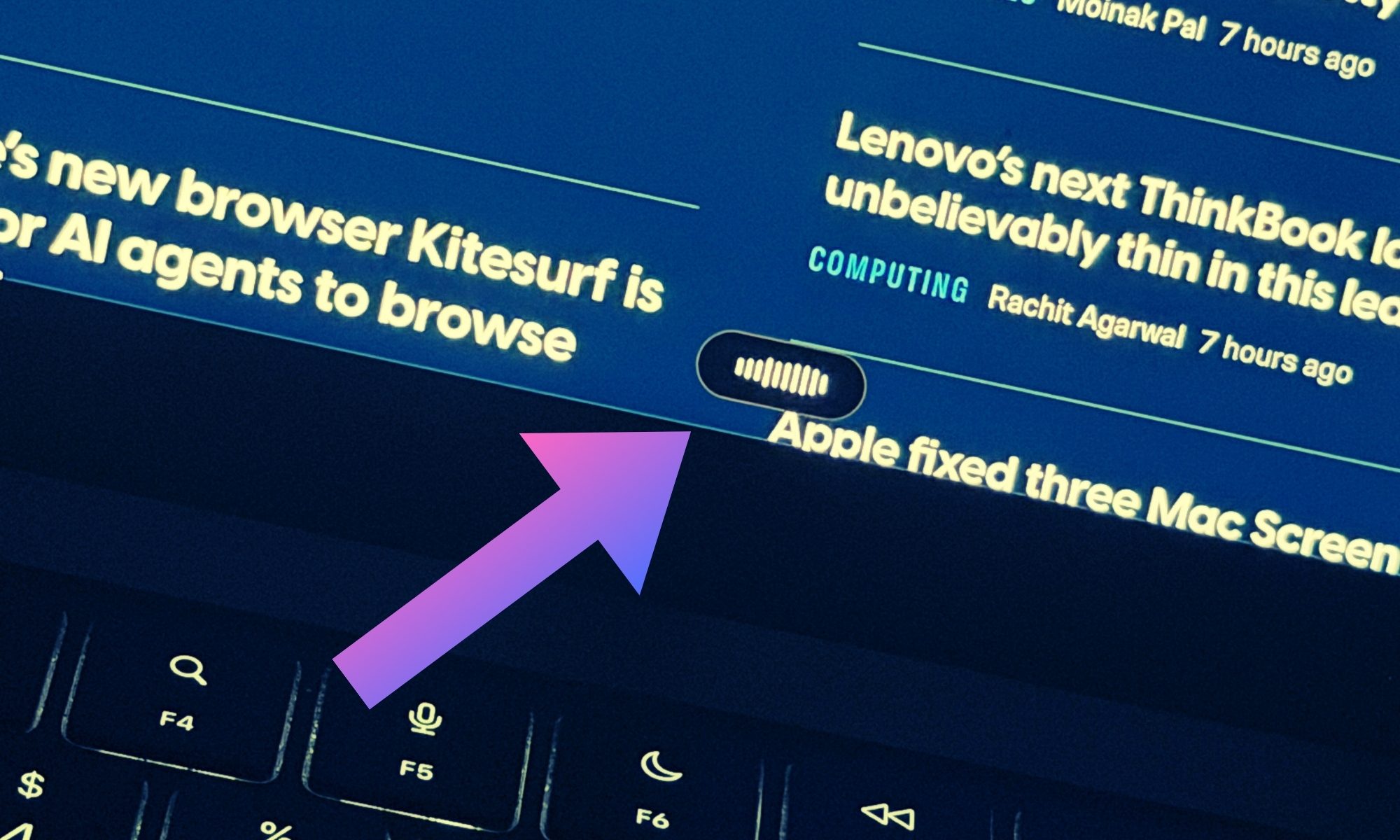
Typing continues to feel tedious, and despite some of the annoying typos due to my accent issues, I still find myself long-pressing the fn button to just narrate my articles, compose long messages to teammates, or even just my usual back-and-forth with Claude for pet projects.


It’s just liberating, and at the same time, it frustrates me every time I go back to a task that requires manual work on the keyboard.
This is also where the situation gets a tad embarrassing for me. It doesn’t matter whether you work in an office space or you are one of those people who carry a laptop to a nearby cafe for your daily work. If you are someone who stares at your laptop’s screen and keeps talking for long spells, it just feels weird.
Now the ubiquity of wireless earbuds makes the situation just a tad less embarrassing. AirPods have made it a natural sight to see people just walking around and talking to themselves, while the onboard mic on the earbud captures and transmits whatever it is that they are speaking. But talking to a person and a computer are two entirely different things.
When you talk to a person, there is usually a sense of friendliness, humility, and, most importantly, human emotions involved. When you’re talking to a friend on a phone call, you don’t feel uneasy. If you took the call in a public place, it has just become a part of our normal lives to talk without holding the phone close to our ears.
But when you are talking to a computer, there are no emotions involved. You sound robotic and use words that you would ordinarily not speak when talking to a human being. It’s just a set of instructions, but AI models these days are smart enough to turn those incoherent sentences into something meaningful and proceed with them as commands.
I feel conscious every time I start narrating an article or a message. “Why is this guy suddenly talking about Anthropic’s AI model going rogue and hacking third-party services?” “Why is he rambling about Google fixing a Bluetooth bug on its Pixel phones?” “Why is this guy randomly and intermittently speaking about following Apple’s UI design rules?”
All the above situations are a part of my daily job, and I am not embarrassed about doing my job. I love it. And yet, every time I use voice narration in a co-working space, a library, or my nearby coffee shop, I am afraid that the person next to me is having those thoughts about me.
Maybe, I just need to muster some courage?
Yes, the world doesn’t care or know who I am. A random stranger shouldn’t pay attention to what I do with my computer, either. But the social norms and how human awareness works make me feel uneasy every time I start talking to my computer.
It’s 12:42 AM right now. I am narrating this article using Willow Voice, and I’m still concerned that my neighbor upstairs, or in the next apartment, is going to hear me randomly talking about voice dictation in the middle of the night. I enjoy the perk and how I have been able to draft this article in less than 15 minutes.
I still feel a sense of unease every time I summon these unnaturally accurate and efficient voice dictation tools on my computer. I fear I will only get used to it when the whole world gets voice-pilled at their jobs. For now, I will keep my computer talks limited to cozy apartments with the windows shut.
