




One thing that seems certain in video games is that if a legendary developer neglects a beloved franchise, an indie studio will pick up the ball and run with it through a spiritual successor. We’ve seen it in spades with Metroid and Castlevania, and with how long its been since we’ve received a Star Fox game, it was just a matter of time before something like Fur Squadron Phoenix came along. A prequel to 2023’s Fur Squadron, Fur Squadron Phoenix brings more modern visuals and missions than its predecessor, and in the process, delivers the Star Fox 64 successor I’ve wanted for nearly three decades.
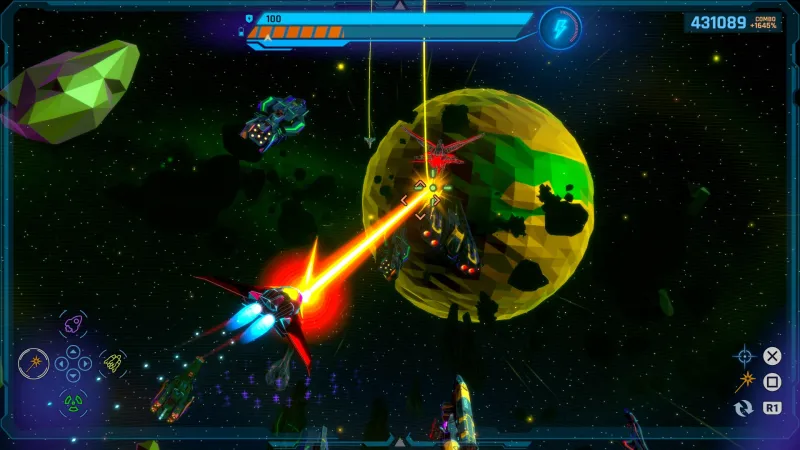
Fur Squadron Phoenix places you in the cockpit of a Starfighter as part of Fur Squadron, an elite group of fighter pilots who serve the Federation. The on-rails gameplay immediately calls back to the best sequences in the Star Fox franchise. You fly through a diverse collection of planet-bound and space environments, blasting away at the many enemies who dare take you on. As you play, you encounter standard enemies flying in formation, shielded ships that require charge shots or special weapons to take out, mechanical worms that emerge from hiding spots to fly straight at you, and, of course, end-of-level bosses that task you with dodging their attacks and blasting their weak points. Thanks to its colorful neon glow, superb soundtrack, and masterful pacing, Fur Squadron Phoenix presents consistently exhilarating dogfights that are absolute treats for the senses.
The waves of enemies that fly towards you often presented unique challenges that kept me on my toes, and truly made me feel the progression of not only my skills, but also my characters. Meanwhile, the boss battles are largely inventive, providing an exciting culmination of each stage; I just wish I could say the same about the final boss, which is an arduous, bullet-spongy practice in patience that did little to put an exclamation point at the end of the otherwise fun campaign. And despite how much I loved my time with Fur Squadron Phoenix, I was also left wishing there was more to it, as eight stages – even if they’re lengthy – fly by quickly.
Despite how short the campaign is, you’ll still have thousands of enemies to blast. Thankfully, you have an ever-improving arsenal that is unlocked through roguelite-inspired mechanics. Rather than unlocking upgrades through in-level items, you instead earn upgrade points every time you play a level – win or lose. This makes it so even my bitter losses at the end of a long stage didn’t feel like a complete waste of time. The majority of the game takes place within a training simulation, but bafflingly, you don’t earn any skill points in the real in-universe missions; these stages should feel more impactful and memorable, but instead, because of this arbitrary system, I always opted to replay the simulation missions.
Upgrades available include damage boosts (including a permanent double laser), improved shields, and increased mobility. Obviously, improving health and damage is always great, but I especially loved pumping points into the four distinct special weapons. The standard Star Fox-style bombs are your default, but I quickly gravitated to a power beam that increases in damage as you use it, or the extremely useful multi-missile special weapon. Then, there’s the nuke, which is also extremely useful in situations with a ton of enemies. These specials, when fully upgraded, can decimate the opposing forces. And when combined with your Overdrive ultimate ability, which slows time and increases your damage, you have more ways than ever to satisfyingly take down incoming adversaries.
Through most of the game, you play as Robin, a bird who was previously a part of Phoenix Squadron. When Robin’s crew is decimated during a mission, he’s rescued by Fur Squadron, which consists of a ferret named Blaze, a fruit bat named Kiro, and an Axolotl named Axel. Each of these characters fits into the archetypes established by Star Fox: Blaze is the brave and fearless leader, Kiro flies like he has something to prove, and Axel is a tech genius. As you play through levels, each teammate will give you side objectives to complete, such as saving them from enemies on their tails, clearing a path of all debris, or flying through rings. By completing these, you level up the character who issued the challenge, which improves your Overdrive.

By the end of my playthrough, in addition to slowing down time, my Overdrive fully refilled my health and special weapon energy, plus gave my lasers a 260-percent damage buff. Additionally, each time you level your relationship with a specific character, you get a touching post-mission scene between Robin and that character. These scenes go a long way towards establishing personalities, connections, and narrative subplots, which is all extremely helpful since your squad mates’ voices play as gibberish rather than real voice acting. This isn’t a dealbreaker by any means, but when Star Fox 64 was able to have fully voiced characters in 1997, it’s disappointing to have to take my eyes off the action to read what they’re saying while in a mission.
Though Fur Squadron Phoenix draws heavy inspiration from Star Fox, it leaves out smaller pieces of the formula. First, this a single-player title with no multiplayer, so if, like me, you have fond memories of competing in four-player dogfights, you won’t find that within this package. Additionally, the levels are completely on rails, meaning that even in encounters that might make sense for it, there is no All-Range Mode to allow for free flight. Thankfully, for boss encounters that feel like they’d play better in something akin to All-Range Mode, Raptor Claw found creative ways for it to feel dynamic in a similar way.
Despite those deviations from the series that inspired Raptor Claw to develop this game, Fur Squadron Phoenix is an excellent spiritual successor for those who remember that Fox and Falco exist outside of the Super Smash Bros. games. Nintendo may not know what to do with the Star Fox franchise, but Fur Squadron Phoenix makes a great case that the genre can still flourish in 2026.


