



Back in June, I traveled to Osaka, Japan, to visit Capcom’s HQ and play never-before-seen parts of Onimusha: Way of the Sword for hours, interview the team making it, and more. I did so to write Game Informer’s latest cover story (that subscribers can read right here), and as part of my coverage, I’ve been posting all kinds of exclusive behind-the-scenes features, interviews, news breakouts, and more; all of it can be viewed at Game Informer’s Onimusha: Way of the Sword hub.
One of the most exciting parts of this cover story trip was playing through a stage set in the mysterious and terrifying underground lab that’s home to Dokyo, one of the more standout Genma players will encounter in the game when it launches next month. Below is an edited version of my preview thoughts on this section from my cover story, highlighting what I thought of Dokyo’s classic Japanese ghost house-inspired lab alongside developer commentary I received from interviewing the Onimusha: Way of the Sword team at Capcom.

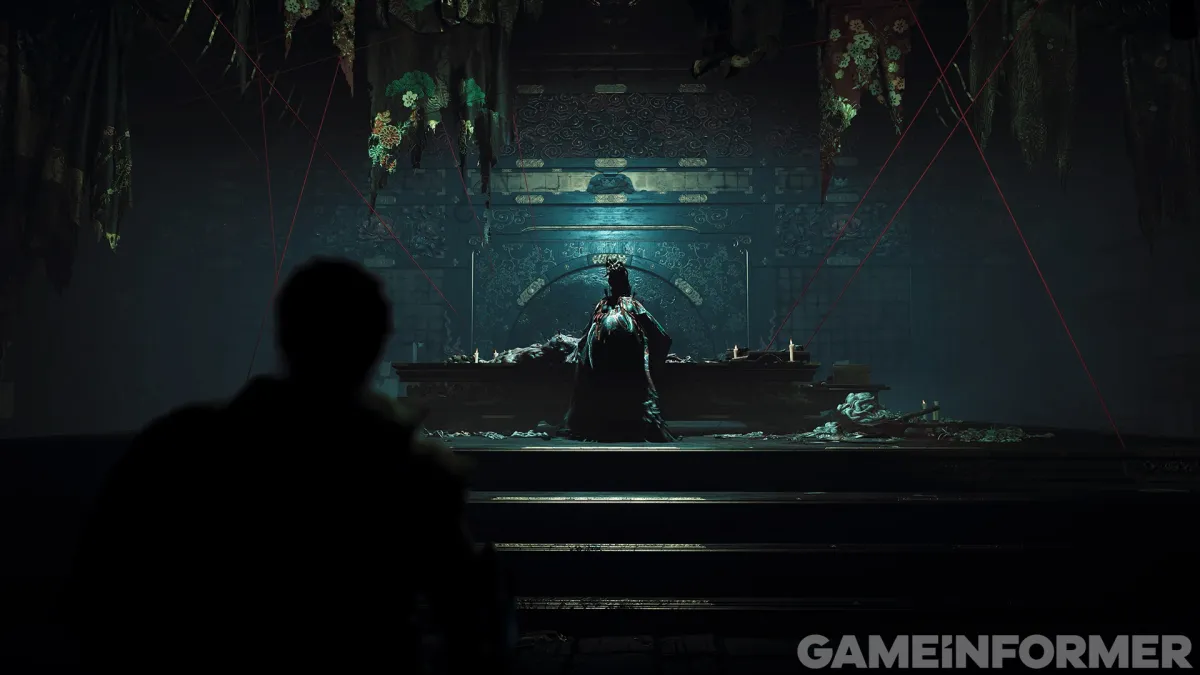
Director Satoru Nihei introduced this stage as one of the more horrific in Way of the Sword’s dark-fantasy action experience, likening it to a “classic Japanese ghost house.” Somewhat familiar with this subgenre of Japanese horror, it’s clear in what ways: shadows on the lab’s shoji highlight horrific body mutations and animal experiments gone wrong. All the while, the halls of this lab are dripping with blood that shines in the soft orange light of torches that illuminate an otherwise dark space; once-beautiful kimonos hang from the rafters above, and I can only assume they belong to the subjects of Dokyo’s experiments.
Dokyo is a shrill, petulant, and evil Genma, though more advanced than the mindless hordes hungry for souls I slice through by the dozen. Dokyo is hiding in plain sight in this underground lab, right beneath the imperial castle of Kyoto, doing unholy things to humans and animals alike in an effort to create even more terrifying Genma. She’s quite the scene-stealer, with a terrifying charisma that makes her the standout character of my time playing Way of the Sword. She’s twisted but determined, and that makes her a compelling voice to listen to as it echoes through this dungeon between my bouts with demons.
It’s this dungeon where I’m freed from the shackles of tutorialization, and it feels like protagonist Miyamoto Musashi has removed weights from his arms – I feel like the master history says this samurai was.
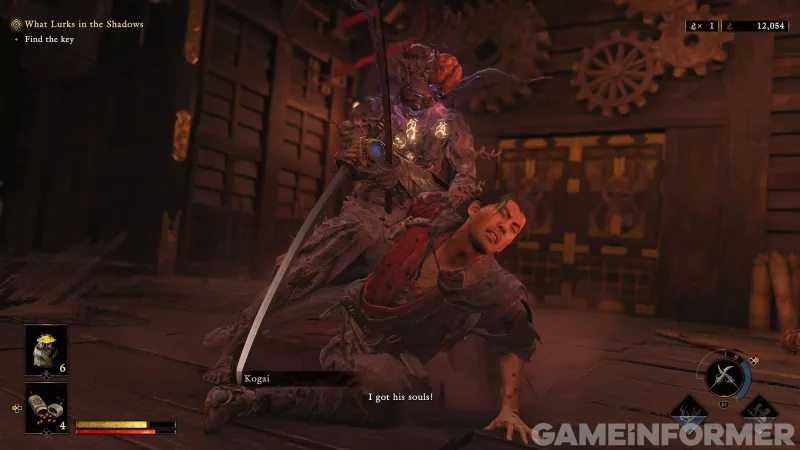
Though I love the action genre, I have admittedly grown bored with a lot of it, at least in the triple-A space. I’m rarely surprised mechanically, and tutorials seldom teach me anything new. I know what the buttons do just minutes into the experience. Way of the Sword is a refreshing change of pace in that regard, as a single playthrough of the game’s demo will see your time paused by a multitude of tutorials. The Issen returns – press one of the attack buttons just before an enemy’s hit lands to perform the deadly counter that’s been in Onimusha since the first game. Don’t worry, it’s still the hardest move to pull off in Way of the Sword, just like in older titles, as it requires the strictest timing.
But there’s also the standard Parry, which fills your Blazing Gauge that automatically lights Musashi’s sword up with blue flames for increased damage, and the Reflex Dodge, which fills your Reflex Gauge and sets Musashi up for a massive blow to an enemy’s back or side. The Break Issen attack can be performed when you have exhausted an enemy’s stamina enough, and you can significantly deplete that stamina with a deflection – swords, arrows, you name it, you can deflect it. You can also perform Chain Issen attacks to slice through multiple enemies in an otherworldly flash, and you can backstab unaware enemies for stealth insta-kills.
Are you following?
When you and an enemy perform the same type of attack, a Blade Barrage occurs, and to win, you need to use a sword attack other than the one you used before it to end the stalemate and damage the enemy. There are grab reversals, too, and Oni Armaments, which are powered-up bumper attacks that do a variety of things depending on which you have equipped – the Two Celestials, for example, do straight damage, while the Earth-Shaker hammers I utilize in the underground lab hit an enemy’s stamina bar heavily.
Within this multifaceted combat system, there are additional layers of complexity. I especially like that the sparks that fly from your blade and the associated sounds change depending on how early or late your parry attempt is. It is both a helpful notification of my parry timing and a diegetic gauge for improvement. When fighting bigger enemies like bosses, you can even choose where to place a Break Issen. For example, against Rasho-gan, I can target his head for extra damage or his torso for additional yellow health-granting souls.

It’s a level of expression contemporary action games have forgotten, but in hindsight, it’s exactly what I expect of the latest Onimusha game. After all, that combative creativity dates back to Onimusha: Warlords.
“Obviously, in the previous titles, Issen does feel great to use and pull off, but it happened so fast […] it’s hard to tell exactly what’s going on in that moment and so one of the things that Nihei-san approached me about with this title was trying to make the Issen a little more realistic and a little more grounded – like what would that look like, what would it feel like?” animation team lead Hiroshi Yugen tells me. He adds that there are around 10 different variations that Musashi can pull off depending on attacks coming from different angles and more.
Yugen’s biggest goal with Way of the Sword’s combat was to take the larger-than-life moments present in the cutscenes of previous Onimusha games and imbue the gameplay with that feeling. What was once only possible in Onimusha cutscenes is how Way of the Sword plays. That’s highlighted best in this underground lab, as I slash through dozens of Genma, splitting their fleshy corpses and watching as two distinct halves slide to the wooden slats below. Yugen calls it the “Dynamic Dismemberment System,” and I can already imagine the ways the Resident Evil developers in nearby offices might use this technology in new games.
“[This dismemberment] is not something that’s existed in any other title before, and it’s something that, on a technical level, needed to be added to the RE Engine [by Capcom’s engineers],” Yugen says. “Adding this feature was quite difficult because we wanted to combine it with the enemy deaths. In a lot of samurai dramas, they have a very exaggerated classic death where they are on screen for an extra five or six seconds and then slowly fall to the ground. To have that together with this dynamic dismemberment system on a technical level is quite tricky, so it’s something we really had to ask the programmers to introduce.”
The result is a satisfying death animation for every single Genma in the game, assuming you deplete their stamina like a proper samurai and enact the Break Issen or one of Musashi’s various other finishing moves. Between this cover story and multiple playthroughs of the demo, I’ve played probably four hours of Way of the Sword, and the dismemberments remain a delightful, if grotesque, visual to see on screen at the hands of my blade.
Yugen teases the behind-the-scenes motion-capture videos, bragging like a proud father about how the various swordsmen who performed the actions for this game went to great lengths to sell the effect in the studio. Motion capture is one of the ways Yugen and Nihei hope to make Way of the Sword feel like a modern action title. There are exaggerated elements but Yugen stresses that real-life samurai experts and choreographers performed the actions of Musashi as well as the larger-than-life movements of bosses like the eight-armed Rasho-gan and Dokyo, with her extended neck and uncanny appendages.
These technical, visual, and mechanical achievements are on display in the two boss fights of the underground lab. While searching for a girl trapped somewhere within, Musashi comes face to face with Byakue – Hundred Defilements, a boss that grows stronger the more you damage it. While I’m one to rush into combat swinging left and right, Byakue forces me to adjust my playstyle on the fly. I stay back, watch his wide-swinging moves and lunges, and look for entry points to do the most damage. My eyes widen as I deflect one of his spinning blade attacks, metal sparks showering the stage – it’s yet another moment where I just feel cool. This sentiment is present throughout my time playing Way of the Sword, and I appreciate that the Onimusha series hasn’t lost its touch in the 20-year absence.
Defeating Byakue yields me the aforementioned Earth-Shaker hammers, which become critical to defeating a dual-chimera boss at the end of the stage. These Chimera, called Nue in this fight, are a pair of mythical beasts inspired by various animals, one red and one blue, with electric tails that, yet again, force me to adjust my playstyle on the fly. Rushing in with slashes and swings only ends in Game Over screens. Instead, a defensive approach is required, as the only path to success is one of parries, Reflex Dodges, and Issens. While I’m wary of even bringing up a Soulslike comparison – and don’t worry, Nihei and the team stress to me that Onimusha is absolutely not a Soulslike, and I concur – I am reminded of moments in FromSoftware games where the best strategy is to learn the boss’ attacks and simply counter them all.
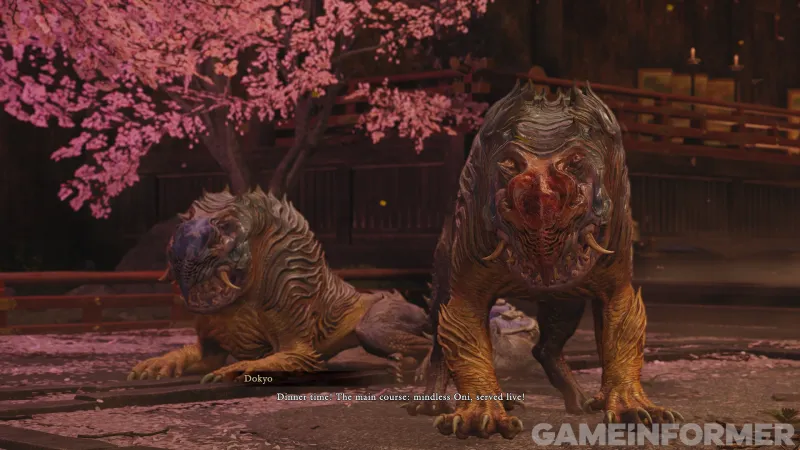
That’s what I do against the Nue, and after the umpteenth Break Issen, I am successful (and scared, because Yugen teases that a larger chimera boss awaits me later in the game). A closing cutscene of Dokyo’s bloody labyrinth is my reward, and though I won’t spoil what I see, I’ll reaffirm that Dokyo is the most compelling character on screen in Way of the Sword so far.
I’ll continue diving deeper into Capcom’s return to Onimusha as part of Game Informer’s month of Way of the Sword coverage. We’ll be publishing exclusive gameplay and behind-the-scenes videos (including a Rapid-Fire Interview) on the Game Informer YouTube channel as well. Keep an eye on the Onimusha: Way of the Sword coverage hub so you don’t miss any of it.

In the meantime, here’s some additional Onimusha: Way of the Sword reading for you:
Are you playing Onimusha: Way of the Sword next month? Let us know in the comments below!