




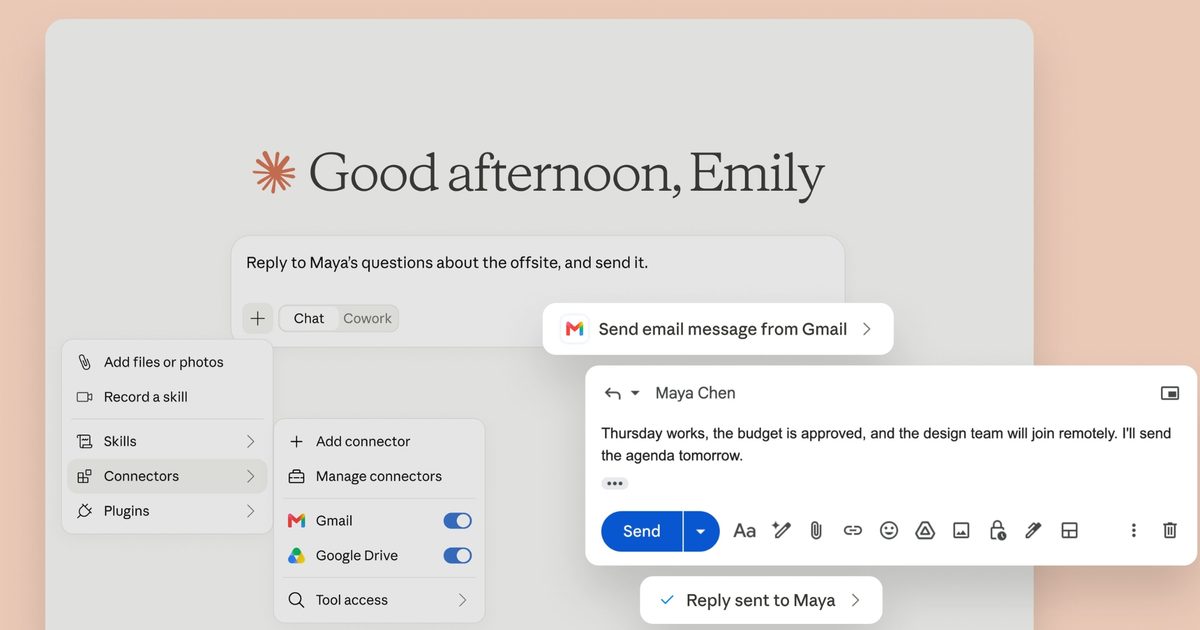
Claude is taking another step toward becoming an AI assistant that can actually get things done, rather than simply telling users what to do. Anthropic has expanded Claude’s Gmail integration, so the AI can now reply to, send, and forward emails on a user’s behalf without requiring approval every time.
The capability builds on an existing Claude connector for Google Workspace, which already allowed users to work with Gmail, Google Calendar and Google Drive. Sending an email was the notable missing piece. That changes with the latest update, although users still control whether Claude needs permission before sending messages.
Claude can now take Gmail off your hands
Users can ask Claude to respond to an email thread, and the AI can draft the response and send it. The important change is that Claude no longer needs to stop and wait for the user to manually approve every outgoing message when the appropriate setting is enabled.
Anthropic says approval remains the default. Users can choose whether Claude needs confirmation before sending emails, while Team and Enterprise administrators can determine whether members are allowed to let these actions happen without repeated approval. The feature is available only on paid Claude plans.
Claude can also forward emails, expanding the feature beyond simple replies. That turns the Gmail integration into something closer to an assistant operating inside the inbox rather than an AI that merely summarizes messages or writes suggested responses.
The distinction matters because sending an email is fundamentally different from generating one. A chatbot can produce a perfectly written reply and leave the final decision to the user. An agent that can actually press Send crosses into taking action on the user’s behalf.
The useful part is also the risky part
For people dealing with repetitive email, the change could save considerable time. Routine replies, follow-ups, and forwarding messages are precisely the sort of tasks an AI agent can handle without much human involvement.
Giving an AI permission to send messages also introduces an obvious question: what happens when Claude misunderstands the context? An incorrectly worded draft is easy to fix when it is sitting in the compose window. A message that has already been sent is another matter.
Anthropic’s approval system provides a safety valve, but the decision to remove that checkpoint puts more responsibility on users and, for workplace accounts, administrators.
The development also signals where AI assistants are heading. The goal is increasingly not just to answer questions but to interact with the services people already use and complete tasks inside them.
Claude’s Gmail capabilities are currently limited to paid plans, with approval settings varying according to the account type. For users willing to give the assistant more autonomy, email could become one of the first everyday tasks where AI moves from suggesting an action to actually carrying it out.
