INTRODUCTION
The Fallout franchise possesses one of the most unusual and fascinating histories of any gaming franchise. Starting as a side project for a programmer who tried to recruit coworkers through an office pizza party, the franchise has blossomed over its more than three decades of existence into a triple-A juggernaut and a critically acclaimed, award-winning Hollywood series.
We spent hours picking the brains of those who were directly involved with the creation of Fallout, as well as those who have ushered the series into its current era. This is the oral history of Fallout.
The Oral History Of Fallout Guide
The Creation of Fallout
Part I
In 1994, Interplay Productions already had several hits under its belt, both as a developer and publisher. Series like ClayFighter, Alone in the Dark, and The Bard’s Tale established it as a successful company, but it was a 1988 post-apocalyptic strategy RPG called Wasteland that drew many fans to Interplay.
FALLOUT: A NUCLEAR ROLE PLAYING GAME
FALLOUT: A NUCLEAR ROLE PLAYING GAME
“We were a B-tier side project”
BRIAN FARGO
Co-founder and former CEO of Interplay Entertainment, creator and director of Wasteland
It goes back to this obscure board game called Tunnels & Trolls, and then that became Mercenary Spies and Private Eyes. That was a skill-based RPG system that I was looking for that could simulate real-world things, because most things were fantasy or science fiction, but there was “lockpick” or “climb walls” or “Uzi,” you know, “machine guns,” that sort of thing. So, I gravitated towards that system and we licensed it, and that was the genesis of Wasteland. Wasteland, to me, is what set the imprint in terms of innovation, such as grey morality and non-linear gameplay.
TIM CAIN
Co-creator and producer of Fallout
I was making engines kind of in my spare time. My job at the time, at Interplay, I was making installers for a few other games, because when games used to come on physical floppy disks – multiple ones – you had to have an installer, and there were a whole bunch of parameters for them.
I made a sprite engine that I showed Leonard [Boyarski] and a few other people, and it was just sort of like, “We should make a game with this,” but I didn’t have anything assigned and I wasn’t allowed to approach them because they were on other projects. So, what I did was I reserved a conference room for 6 p.m., which was when everybody was supposed to go home, and then I sent emails saying, “I’ll be in that conference room with pizza if you want to come and talk to me about games we could make with this sprite-based isometric engine.”
I really thought that tons of people were going to show up, but I think it was about eight people showed up. And I didn’t realize at the time, but I was self-selecting for go-getters, and Leonard was somebody who came.
LEONARD BOYARSKY
Co-creator and art director of Fallout
I don’t remember it, to be perfectly honest, because he showed us a bunch of stuff! He showed us a 3D engine, he showed us a voxel engine. It was kind of, you know, we were just looking at different stuff. Eventually, when we talked about what we were going to do, as the art director, as much as I thought 3D would be cool, you really couldn’t do very detailed work in 3D at that point in time. That’s when we decided to go with the sprite engine, which he already had. I probably just thought, “That’s cool. Can we make something with it?” [laughs]
CAIN
Wasteland, which Interplay had made before but didn’t own the rights to it, didn’t factor huge into that. People talk about how much it’s got an influence. Some of the people on the team really liked Wasteland, and everybody looked at it, but we wanted to do our own thing. I used to run tabletop role-playing sessions, and I really liked [the Generic Universal Role-Playing System] GURPS, so we actually started off trying to make a GURPS-based game.
FARGO
When we kicked off any titles at Interplay, we would do what’s called a vision document, which was, “Okay, what are the tenets of this product?” I remember there was a lot of back and forth, and you know, what were the aspects of Wasteland? Because it started off as a sequel to Wasteland, and then we ended up having to pivot because EA said, “No, not going to happen.” We were being hopeful for a while, but ironically, that pivot ended up being wonderful because we ended up with Fallout, which obviously ended up being a good thing.
CAIN
We talked about a bunch of different ideas before we landed on [post-apocalyptic], but I think the driving force for going post-apoc was Interplay, at the time, was already making several fantasy games. So, we’re like, “Let’s not do that.” So, we talked about various things: There was a time-travel game, there was an alien-invasion game, and we settled on post-apoc; we all just kind of liked it.
BOYARSKY
The main starting impetus was, like, we didn’t want to make a fantasy game. We very quickly decided on science fiction; it just took us a while to get to post-apocalyptic. But once that was on the table, I think it was fairly unanimous almost immediately. We all thought that was a great idea.
FARGO
I’ve got to give it to Leonard: Everything down to the blue and yellow jumpsuits, down to each of the different factions having a visual representation for what they were. To me, that’s where they sort of took what was there and they expanded upon it, made it a greater thing.
BOYARSKY
I have to give credit to [technical art director] Jason [Anderson], too. Especially the ending or the intro. We worked on that stuff together, and it was almost like a dare, because I was working on what turned out to be the execution scene that was just supposed to be a battle scene in the intro, and I’m like, “Jason, it’d be really hilarious if this guy shot the other guy and then waved at the camera,” and he’s like, “You should totally do that!” So, we’d like egg each other on and do ridiculous things that we originally would throw out there as a sick joke, like, “Oh, this would be really funny.”
CAIN
We just wanted to make the rest of the people on the team go, “That was cool!” So, that’s what we were trying to do. You weren’t trying to impose your idea; you wanted to come up with an idea that everybody on the team would go, “Oh, I love it! That’s really cool. You have to have that!” That’s the reaction you wanted, not “I don’t know about that,” and then you have to convince them. You’d come in in the morning and go, “I had this really cool idea, and I think everyone’s gonna like it.” And that went for everything from humor to monsters to weapons to unusual quest ideas.

BOYARSKY
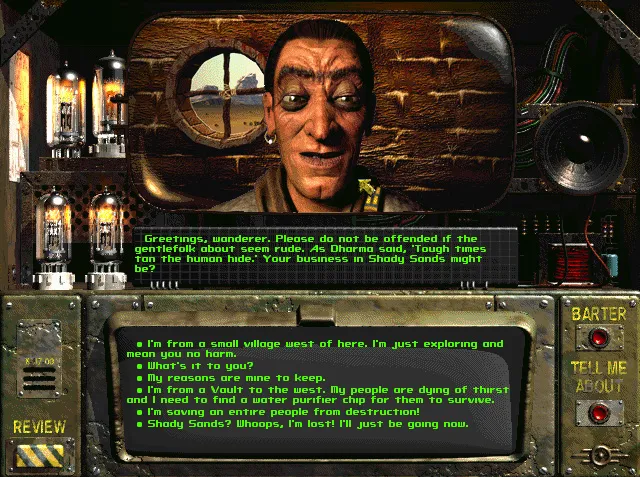
A lot of the humor that came from me and Jason was literally stuff that we just wanted to try and make Tim laugh, like the Radiation King television. I didn’t tell him I was doing that. Jason would get so irritated: Me and Tim would start throwing Simpsons quotes back and forth in meetings, and so, I’m like, “I’m going to call this a Radiation King,” and didn’t tell him. He didn’t see it until he saw the intro, and of course, he laughed because he thought that was a funny Simpsons reference.
That’s the other thing: When we did humor, when we did easter eggs, it wasn’t like we just wanted to throw it in there. It’s like, “What are we going to throw in there when we’re doing that kind of thing? Does it emphasize what we’re doing? Is it a great thing, regardless of the reference?” If you had no idea about The Simpsons, a TV being a Radiation King in Fallout is funny. Now, granted, that’s like us kind of stealing their joke, but it still works, so you don’t have to know about it. And that was our thing.
CAIN
We made this game for each other. When it shipped, we were like, “Well, I hope other people like it!” [laughs]
BOYARSKY
I remember for some reason, we had nowhere to meet at one point, and we ended up meeting in Brian Fargo’s office. It was the core team, there were maybe, like, six of us, and I don’t know why I put these two together, but it was really just a surreal experience. That’s where I started really pushing the idea that we’d have these over-the-top, really violent deaths, which to me, were basically like an R-rated version of Warner Bros. cartoons. It was supposed to be that over the top. It was supposed to be funny. It wasn’t supposed to be taken seriously. It was supposed to really be this dark humor and come across as funny. That was something that Tim was into immediately.
CAIN
It was a cool idea, but because I had to code it, I had to hook it to things. So, I remember going back and said, “I need a few more,” because I wanted one for every damage type. I want brutal bullet, brutal fire, brutal plasma, brutal electrify, and they’re like “Okay,” because we hooked it by damage type. So, if you took a lot of damage, it locked you really far negative, so it killed you. We picked a death based on the damage type, and just showed an awful way for you to die.
And there was a setting, and I think it was [lead designer] Chris Taylor had the idea, “Why don’t we have a setting that you can just say, ‘I always want to see those deaths, even if I didn’t do a lot of damage? If I kill them, show the brutal death based on the damage type.’” And we called that the Bloody Mess combat setting, not to be confused with the Bloody Mess combat perk, which says people always die in the worst possible way.
BOYARSKY
We started making, like, an homage to [Mad Max 2:] The Road Warrior because me and Jason were huge Road Warrior fans. Jason was the technical art director. He was the conduit through which me and Tim communicated. Like, he was an artist and he was a tech guy, and he was trained in neither one of them, but he knew what Tim was talking about and he knew what I was talking about, so he could translate and he was a great support on the art side. He did fantastic artwork on the game, and without him, I don’t know that I could have gotten it done at all.
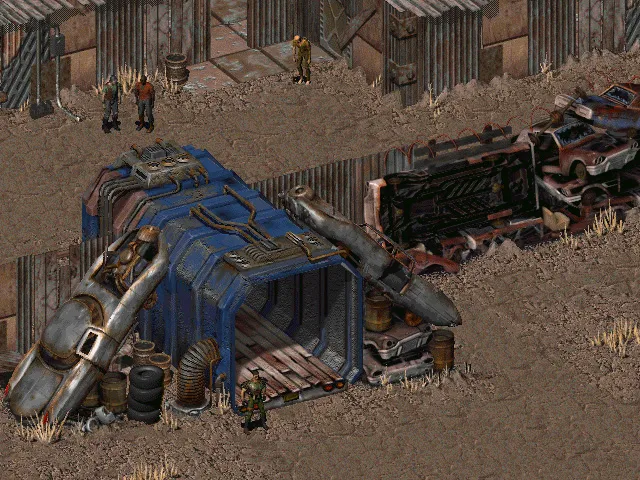
But we were just, me and him, making this really cool homage to The Road Warrior, and then, for some reason, I just started having this weird idea that it should be this 1950s retrofuture. Tim was not quite sure if that was a good idea. I told that idea to Rob Nessler, who was the 3D art director at the time – he’s the studio art director of Obsidian right now – and he was very supportive. He was like, “I’m not really sure I know what you’re talking about, but you seem really enthusiastic about it, so you should go do that.”

FARGO
Leonard deserves so much credit, because I think the visual design was very much Leonard. The whole retro-‘50s style, the mixture of the ‘50s with its innocence but yet with the violent nature. That, of course, translated across the music you were hearing, in their case, more ‘30s music, but you still had hyperviolence with sweet music. In the opening scene, you had the guys waving at the camera after they just executed somebody. All of that mixture of the innocence with the brutal violence, and then also, what they also did a great job with was all of the iconography, because Wasteland didn’t really have any iconography.
CAIN
There are several stories that Leonard or I could tell where Leonard had an idea, and my reaction was, “I don’t know…” After Fallout ended, I just learned, “Okay, Leonard, let’s do that. I don’t understand it. I can’t visualize it, but let’s do it!” because everything from the ‘50s retro-futurism to the ending of the game were Leonard’s ideas that I originally went, “I don’t get that,” and I just learned to go, “Let’s do it,” because now it’s all iconic.
BOYARSKY
The thing that came out of that was we had all these icons that it was very hard to tell what they were. There were so many different things you could do – this is still when it was GURPS – there were so many different things you could do with GURPS skills, all these other actions you could take, so we made an icon for all of them, and I art directed them, and I couldn’t tell what the hell each one was, and I was part of the process of making them!
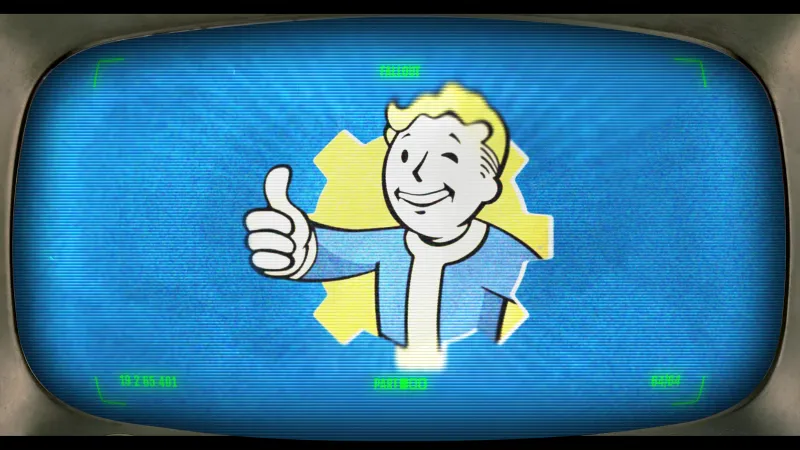
I was driving home one night, and I’m like, “We should have something, like a deck of cards – like Monopoly cards – and some guy who looks like the Monopoly guy, and he should always be happy; if he’s standing there with his hands blown off because he had a critical failure, he’s smiling about it.” And that one, everybody got immediately when I pitched him. I showed him the drawing. He’s a little bit skinnier than he ended up, but it was pretty much the Vault Boy that we know and love. He’s taller and skinnier than he ended up, but everybody got that immediately, and everybody loved that immediately… at least on our team. [laughs] There were some naysayers… [GURPS creator] Steve Jackson didn’t really care for him.
Upon attempting to license GURPS Steve Jackson Games for Fallout, the team learned that Jackson isn’t a fan of the ultraviolence on display and the seeming trivialization of it through characters like Vault Boy. He declined to license GURPS for the project.
BOYARSKY
We couldn’t use GURPS, so Tim and Chris Taylor came up with the SPECIAL system, which was way better for a computer game than trying to make a really faithful GURPS adaptation.
FARGO
[Wasteland] used skills in the environment, which was fairly unique. Fallout then took it one step further and said, “We’re going to use skills not only in the environment, but also in conversation.” And so, it took it one step further. And then, of course, did things like use attributes like “Low I.Q.” which was a hilarious way to play.
BOYARSKY
It was very insular. It was very much like, here’s our team off in the corner, and there’s the rest of Interplay, which kind of was a great thing, and I was aware enough to know this is weird in a really good way. Like, this doesn’t happen. This is like we’re making an indie game, but we have a steady job, and we have steady paychecks, and we’re not trying to find a publisher for it, because once they saw what we were doing – and they appreciated what we were doing – they’re just like, “Well, we have these much more important games! The Dungeons and Dragons games are licensed to print money. Just don’t bother anybody. Just go over there and do your thing and it’ll be great.”
CAIN
We were a B-tier side project at Interplay. They got the D&D license about six months to a year after we started, and they’re like, “Okay, that’s the A-tier. Those are the money teams.” And we’re off in the corner.
With the tone and direction largely decided, the team considered what to call the game.

FARGO
There were a whole bunch [of names considered]. Vault 13 was one of them. Of course, it was going to be called GURPS something, and that could have been GURPS Vault 13, but that still would have been an odd name. There was a list of names that were up and I think Tim has spoken of that.
BOYARSKY
We were horrible at naming stuff! Me and Jason were really down with, “It’s gotta be Vault 13!” which is just like, “Okay, then you can’t tell any stories about anything but Vault 13.” It would have been a horrible name for a series of games, but we weren’t thinking that. We were just like, “Oh, it’s really cool. It’s Vault 13!”
CAIN
What would the sequel be? Vault 13-2? Vault 14? It’s interesting. I keep lots of stuff, and I found a list from a brainstorming meeting that we did on the naming of the game, and Fallout was on the list. But we all went, “It’s too obvious.” I remember somebody went, “It’s 80 years later. There’s no fallout.” Brian Fargo started taking it home on weekends and playing it, and I know this because he called me at home and go, “I’m stuck. How do I get past this?” or “What are you supposed to do here?”
FARGO
I said, “Hey, you know, I think I’ve got a good name for us,” which was Fallout. And naming titles is always tricky because there’s always a contingent that doesn’t like it no matter what. And then you’ve got to sit with it for a while and see if they do like it, but you go, “Well, do they like it because they’ve been sitting with it, or do they like it because they’ve finally seen that it’s good?”
CAIN
My immediate reaction was “Ehh…” But I told the team and we all kind of liked it. It kind of attached because it made sense for a lot of reasons, and including, the whole civilization, everything has fallen out, and this is what’s left.
Years later, I’ve come to appreciate how good Brian was at naming games. I think he named a huge chunk of the games that Interplay put out. He was good at playing a game and coming up with a name that was the essence of it. I especially like Fallout because it’s a short word, and “F.O.” was not an acronym that anyone was using for any other game. In the end, we went with it. I think by the next day, we had renamed everything “Fallout.” The executable was called Fallout. We were already changing the title screen, so it happened really quick.
As Fallout development progressed, Interplay caught wind of the project’s potential and staffed up on Fallout. Before the first game was released, Interplay established a second team in charge of pitching and starting development on a sequel. The goal was to release Fallout 2 one year after the first game.
BOYARSKY
Everybody brought their expertise to the table. And it was a very small group to start out with; I think the core group was like 15 people, and then eventually we got up to 30 people. But for a large part of the beginning phases, it was a very few amount of people. Each one of us would bring our thing, like, I bring the art ideas. We’d always discuss the other people’s idea and what was going on in the other disciplines. For a lot of it, we decided a lot of this stuff in terms of tone, in terms of what we wanted the game to be in very large, general brush strokes. Ironically, I feel like that’s the closest to any game I’ve ever made where those initial ideas, at least in terms of the vibe of the game, are what came out at the other end.
CAIN
It’s hard to know what 20-something me would have thought if you had told him back then that this is going to be a huge thing.
BOYARSKY
It was such the definition of “lightning in a bottle.” Every time something went wrong, something great came out of it. […] A lot of this stuff was dictated by our constraints – the things we didn’t have money or time to do, things that went horribly wrong at the time. It seemed like a horrible thing that we couldn’t do Wasteland 2; me and Tim weren’t that much into Wasteland 2, but some people on the team were and from my point of view, it was like, “Wasteland 2 would be good because people would immediately know what it was.”
And Wasteland was a beloved game at the time, even though it was kind of a cult thing. I don’t think there were a lot of games besides things like Warcraft that weren’t cult things at that point in time in the industry. If you sold a million units in that time, you were a huge, phenomenal success! It’s just this thing where there was some kind of being in the right place at the right time where I’d like to take credit for a lot of it, but at the same time, I almost feel like I was just fortunate to be part of whatever energy was flowing in that team and whatever came out of it.
CAIN
So many negatives turned out to be positives – losing GURPS and not getting the Wasteland license – but I’m going to point out that sprite engine I wrote had limitations we had to work around, and those workarounds ended up making the game really cool. But it was one of those things that, at the time, it felt like, “Oh no, another setback,” and it turned out to be a positive thing in the long run. It did help me view things differently years later.
But even being called a B-tier product, which, at the time was an insult, you know, “We can’t wait for you to get done with this so we can put you on D&D or something,” turned out to be a great thing because we were pretty much ignored for years. No one really cared about what we were doing because there wasn’t anything huge tied to it, and that just let us kind of do our thing.
BOYARSKY
No one was telling us what the quality level of the game had to be. We were totally left alone, so we could have cut corners, but we refused to ever cut corners, to the detriment of our personal lives, but I think, all to the better when it comes to Fallout, the quality of it, and, I think, people’s reaction to it. I think you can feel how much love we had for what we were doing when you play it.
CAIN
Our work/life balance was terrible. [laughs] Because features would come up that I should have said “No, everyone’s full,” and instead, I’m like, “I’ll stay late this week,” or “I’ll come in on the weekend.” Or “Yes, we’re throwing that combat feature,” “We’re throwing that extra U.I.,” “We’re throwing that particular thing that people want because, yeah, I can see how it would make the game better. I guess I won’t do anything this month but work on the game.”
BOYARSKY
I wish we had the email, because I sent [Tim] an email. I said, “In a week, everyone’s going to know how great Fallout is” before we shipped. And Tim emailed me back, and he said, “In a week, we’re going to be asking whether people want fries with their meal.” [laughs]
CAIN
That’s true! [laughs]
Fallout: A Post-Nuclear Role Playing Game released on PC on October 10, 1997. The game earned an 89 out of 100 from reviews aggregate site Metacritic, including an 8.75 out of 10 from Game Informer. Early into the development of Fallout 2, Cain and Boyarsky, who felt burnt out from crunch-heavy development on the first Fallout, are assigned to work on the sequel.
FALLOUT 2
FALLOUT 2: A POST NUCLEAR ROLE PLAYING GAME
“We had no editor!”
BOYARSKY
There were a couple of things that they kept – a lot of the main story arc, or at least the beats, and they kept a significant number of side-content ideas that we had that were basically at the idea stage. There were some people who had been on the main team, or the early original team, still there, but a lot of the stuff was driven by me and Tim and Jason, and I don’t mean that to take credit for everything, but we were the people who would say “no.” We were the people who would say “This fits with what we’re doing,” “This doesn’t fit with what we’re doing,” and it was probably a lot wider in the first game than it should have been.
I’ll probably regret forever the fact that I thought it was funny that we had aliens have a velvet Elvis painting, because as much as I love some of the stuff they’ve done in New Vegas with that, that to me is not quite what Fallout is; to me, Fallout was always that reality never existed. The reality that they’re selling people or that they were selling people before the way, was the idealized version of what it is, and that would have never been a part of the culture, because at the time, somebody like Elvis was not part of the mainstream.
CAIN
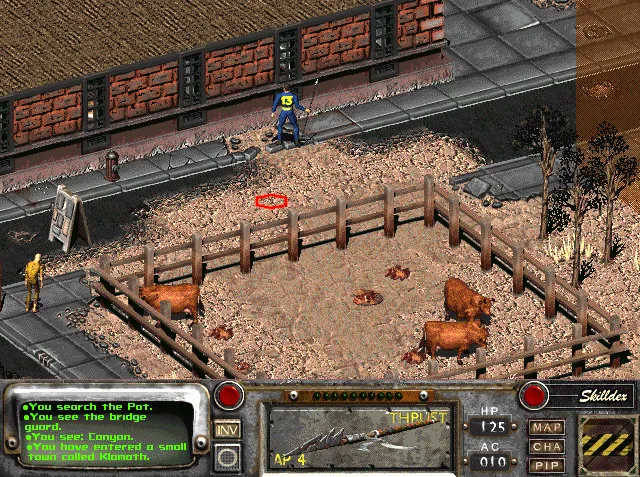
They broke us into groups for each town and these surrounding areas, so that’s why there’s a tonal shift between the towns. There were literally these isolated groups of developers working on it in order to get it done so quickly.
BOYARSKY
Nothing against the people who made it; I think they did a fantastic job. A lot of them worked with us. They had, like, a year. We had three and a half years to make the first one, and they did the second one in a year. I don’t know that they had time to have people going, like, “Okay, here’s the overall tone that we’re going to hit. We’re just going to make sure we don’t go outside these lines.” And I feel like it was kind of just like people were just getting stuff done as quick as they could.
CAIN
We had no editor! [laughs]
BOYARSKY
We threw a bunch of stuff out there that would have gotten us sued today, but that we thought was funny, and we weren’t really thinking, “This should be part of canon.” This is just weird stuff you hit, which is more just our bizarre sense of humor. It just really felt like there was no one there to say, “Hey, you realize if you make a Britney Spears joke, in five years, this is going to seem really, really dated,” or “If you make these easter-egg jokes, if people don’t understand what’s going on, if they don’t get the reference, it’s not funny, and it’s not giving you anything that’s landing in the game for players who don’t understand.”
Feeling creatively stifled, at odds with management, and wanting to work on something besides Fallout, Cain and Boyarsky left Interplay along with Anderson to found Troika Games in 1998. Fallout 2 released on October 29, 1998, to an 86 on Metacritic, including an 8.5 from Game Informer.
FARGO
Prior to me leaving Interplay, I actually was going to kind of restart the entire company. We got too distracted, and I said, “Let’s just focus back on role-playing games again. Let’s go back to our roots and get rid of everything that’s not a role-playing game.” But I wasn’t able to bring that to fruition, and I ended up leaving the company.
Work on another sequel, codenamed Van Buren, went into production at Black Isle Studios, a subsidiary of Interplay, with 3D visuals as one of the key starting points. Meanwhile, developer Mirco Forté released a turn-based strategy spin-off, titled Fallout Tactics: Brotherhood of Steel, in 2001, earning an 82 on Metacritic, including an 8.75 from Game Informer.
Due to clashes with an investment group after Interplay goes public in an attempt to raise funds, Fargo resigned as CEO of Interplay in 2002 and founded InXile Entertainment. Amidst financial strife, Van Buren failed to get off the ground, and Black Isle Studios closed in 2003. Black Isle leadership founded Obsidian Entertainment that same year. Interplay instead licensed the Fallout IP to Bethesda Softworks, the studio behind the Elder Scrolls series.
FARGO
We wanted to do more with it, and I know that there were different discussions of Van Buren and what Fallout 3 would have been. Way after me – I was at least around for parts of that – they started talking about doing a massively multiplayer game with it. That’s whole other thing I wasn’t involved with.
Bethesda did a licensing deal for Fallout, and they were going to pay them a royalty, like 10 percent or whatever it was. During that time, I had my people, you know – I use to run the company and I was running a college or something – and the employees weren’t getting paid at the time. They weren’t getting paid vacation pay, sick pay, sometimes just salary, and they would say, “Brian, please help. Please help.” I’m like, “Guys, I can’t help. I’m gone.”
Eventually, I said, “Let me do something.” So, I took some creditors, I filed an involuntary bankruptcy, which forced Interplay to say, “Hey, you’ve got to pay your bills or sell off your assets to pay your bills. One way or the other. You can’t not pay all these people.” The only real asset they really had to sell was Fallout.
BOYARSKY
We did try to work with somebody to get money together. I don’t’ know if there was ever actually an offer on the table. I feel like there were discussions, because my recollection was that we didn’t even get a chance. We got some possible investment interest, but we never even got a chance to make an offer, because it felt like the Bethesda thing, it wasn’t announced, but we knew at least six months to a year before anybody else outside of that circle that Bethesda had bought it until it was announced.
CAIN
We hadn’t gotten any investment money yet, but I think one of us had told Interplay we’re putting together an offer. And then we found out, “Oh no, they’ve already gone.” They got a good offer, and they went with that.
FARGO
That lawsuit made them sell all the Fallout rights to Bethesda for [$5.75 million] and that got everybody paid. All my employees, they all got paid. They got paid backpay. When I was doing work with Bethesda, I used to say, “You owe me! You got these rights because of me!” [laughs]
BOYARSKY
We heard and we’re just like, “There’s no chance.” It wouldn’t have mattered if they heard our offer or not. They would have laughed. It’s almost flattering in a weird way that Bethesda thought it was worth that much money. But I also feel like they just wanted to blow everybody else out of the water, which, again, is flattering. They really wanted it, and there was no way we were getting that. They bought it for far more than I think anybody else thought it was worth at the time.
Bethesda Softworks finalized its acquisition of the Fallout intellectual property in 2007. Bethesda subsequently sued Interplay to prevent the company from developing a game called Fallout Online and continuing to sell a newly released bundle called Fallout Trilogy, which included Fallout, Fallout 2, and Fallout Tactics: Brotherhood of Steel. A new era of Fallout officially began under Bethesda Game Studios.
Continue to…