


Eternal Anima is the time-twisting RPG revealed during the big September Nintendo Direct that looked like a Square Enix HD-2D game but isn’t. It is also the game with the “Never Strive For A Better Tomorrow” splash screen. After playing the game for roughly an hour within developer Marvelous Inc.’s Tokyo office, I eschew that line – I will, in fact, strive for a better tomorrow, if only so I can play more Eternal Anima one day.
The world has essentially come to its final act in Eternal Anima. Urvis Ael is the last remaining bastion of civilization in a flooded world. That said, living in Urvis Ael isn’t all that bad; just don’t strive for a better tomorrow or really any kind of change. Protagonist Wade breaks those rules and sets out on an adventure, feeling deep down that a better life is possible.
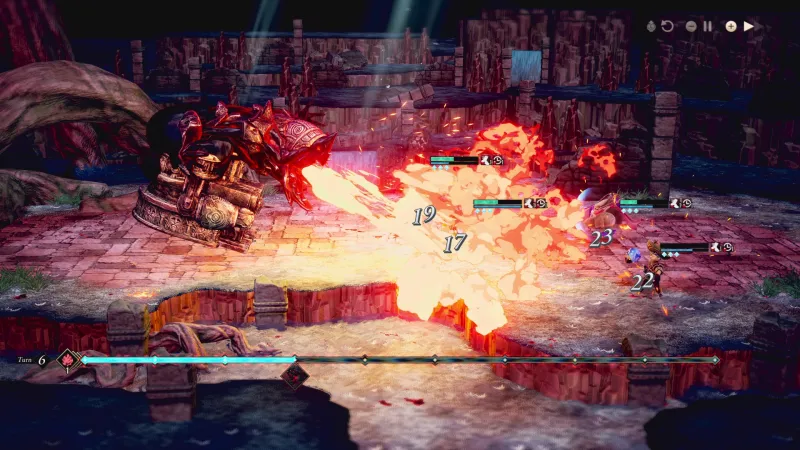
Wade is bestowed with the power of Psychometry, which lets him look into the past, view memories, and inherit abilities and classes for use in combat. My hands-on time with Eternal Anima is mostly focused on combat, and for good reason: it rules. It is turn-based combat, but with a time-turning twist. Wade also has the power of Future Sight, which means he already knows exactly what every enemy will do each turn, reflected in the UI. Every ability has an action speed shown on the timeline at the bottom of the screen. You can always see an enemy’s upcoming action, who they will target, and even the outcome.
Combat in Eternal Anima is less about hitting enemies harder and more about hitting them smarter. When you attack an enemy’s weaknesses with Wade or other party members, you knock them back on the battle timeline, pushing their predecided actions back in the move queue. Your goal is to push them back enough that you kill them before they can attack, or, for bigger enemies, knock them off the timeline in what’s known as a Break. This cancels their action, opening up your party for another round of attacks.
The battle system doesn’t feel as active as a standard turn-based RPG; instead, it makes you feel more like a god playing with action figures. You decide what happens, then sit back and watch it all unfold.
Everything is depicted in a beautiful, bokeh-enhanced art style that’s unique to Eternal Anima, despite the initial HD-2D impression. I love how the world and enemies look, which makes it even more disappointing that the characters are rendered as chibi. It doesn’t gel with the game’s painterly visuals and clashes with its heavier thematic tones.
As I explore Eternal Anima’s miniature settings, which resemble closed-off dioramas placed carefully on a larger world map, I take part in fishing minigames, collect items, defeat enemies, and encounter NPCs from the past, like Fletcher. After I interact with a glowing sword on the ground, an animated flashback plays, detailing Fletcher’s story and ending with a notification that I received a bow from his past.
As I continue through this world, some two centuries before my time, I encounter a man from this period who’s trying to save his forest hometown from flooding. Of course, I already know this will happen in my timeline because the entire world is flooded, but Wade suspects that if he can convince this person of the looming threat, he can change the present by altering the past. My demo ends shortly after, but now, a month removed from the preview, I’m still thinking about Eternal Anima, specifically its combat.
A lot of turn-based combat makes you feel powerful. But Eternal Anima’s makes you feel like a genius, and that’s smart and novel. I’m left striving for March now.