




I have tried AI photo editing tools on a bunch of phones by now, and most of them follow the same pattern. They look great in a demo, seem useful in theory, and then become wildly unpredictable the moment you use them on an actual photo you care about. My issue with AI erasers and other editing tools was how inconsistent they were.
But the Galaxy S26 is proving to be different.
I have been trying Samsung’s AI editing tools on a few real photos, and the thing that stood out was not some wild, unrealistic image-generation trick. It was the reliability. The Galaxy S26 handled the kind of edits I actually need, and it did so quickly enough that I did not feel like I was wrestling with the phone.
The best AI edits are the boring ones
The most impressive part of Samsung’s AI editing suite is how well it handles everyday fixes. I am not talking about turning a cloudy afternoon into a sci-fi movie poster or replacing half the frame with something completely imaginary. I mean removing fingers from the edge of a shot, cleaning up tiny unwanted objects, filling in a background, or making an image better for social media uploads.
One example was a portrait of a friend outdoors. The photo itself looked good, but there was a beer can awkwardly creeping into the right side of the frame because someone was handing it over while the picture was being taken. Samsung’s AI eraser took it out cleanly—and it looked natural enough that you wouldn’t even notice. The background was rebuilt in a way that matched the surrounding landscape, and the edit took very little effort from my side. That is exactly where AI photo editing starts to feel genuinely useful.
I had another shot of the Galaxy S26 showing a Play Store listing, which was meant to be used in my recent “Character.AI gets sued” article that I recently covered. It was meant to be used as the main image, but my fingers were visible around the phone, and the background looked too plain. Using Samsung’s AI tools, I erased the fingers and typed in a prompt for a “sunset glow vibe color” background. The phone rebuilt the scene with a warmer, more polished look that worked far better for a tech article image.
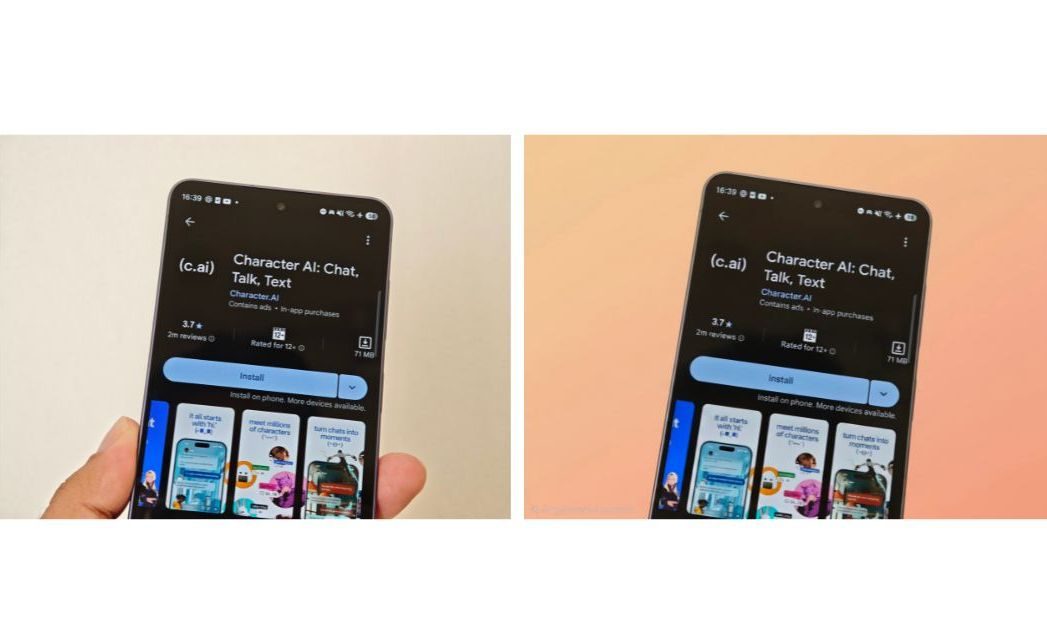
I’ve used Canva in the past for work, mostly to make basic graphs and featured images, but I wanted to see how well a smartphone editing tool could fit into that workflow. I’m not exactly great with picture editing, but the time-saving and simplicity offered by Galaxy AI in the image editor is just scary good. It was a practical cleanup job done right. The edit was quick, the result looked usable, and I did not need to export the image to a separate app.
I have tried similar editing tools on other Android phones, including a Xiaomi device I had around, and Samsung’s version has been the most dependable in my experience. Some rivals can do impressive edits when everything lines up perfectly, but the Galaxy S26 gave me fewer weird misses. It understood the frame better, filled gaps more naturally, and usually got me closer to the result I wanted on the first or second attempt.
The watermark is annoying, but I understand why it exists
There is one thing Samsung does that you will notice quickly. AI-edited images are tagged. The Galaxy S26 adds a visible AI-generated content watermark to the image, and the gallery also shows that the AI tool used was Photo Assist. In the metadata view, the photo is clearly marked as containing AI-generated content. That means Samsung is not trying to quietly pass these edits off as untouched photos.

I have mixed feelings about this. On one hand, the visible mark can be annoying, especially when the edit is minor. If I remove a finger from the edge of a phone shot, or erase a tiny object that slipped into the frame, it can feel a little excessive to have the entire image labeled as AI-generated. The label makes more sense when the edit changes the meaning of the image or reconstructs a major part of the frame. For small cleanup work, it can feel like the phone is over-declaring the edit.
You can slightly crop the image to remove the visible watermark, depending on where it appears, but that does not change the larger question. Samsung’s system is designed to make AI involvement visible, both in the image and in the file information. It is inconvenient for some casual edits, but I also think it is the right direction.
AI photo tools are getting too good to remain invisible. If a phone can erase objects, generate backgrounds, clean up people, and rebuild missing parts of an image in seconds, viewers deserve some signal that the photo has been altered. This becomes even more important when the edit is no longer about removing stray cans or cleaning up a product shot, but changing the whole look of a moment.
Samsung’s AI editor feels ready for real use
What impressed me most about the Galaxy S26 was how it felt ready for practical use. Samsung has worked on making the experience as effortless as it can be. You’re not just choosing and fine-tuning the image; you can type out your feeling or explain a vibe, and the edits kick off. This is the difference between a feature you test once and forget, and one that quietly becomes something you frequent.