




I love video game music, but it can be really difficult to listen to some soundtracks, especially older ones, through legitimate means. Covers, while not the same thing, have always been an easy way around that, and the internet is full of them. I’m especially fond of jazz covers (I’ve been a fan of insaneintherain’s music for years), and I distinctly remember how excited I was when I discovered The 8-Bit Big Band, a large ensemble dedicated to elaborate jazzy covers of video game music, around 2019. When it won a Grammy in 2022 for its version of Meta Knight’s Revenge, I was thrilled, not just on behalf of the band, but on behalf of video game music as a whole, which has never received the recognition it deserved.
I was shocked, to say the least, when I found out that the band’s leader, Charlie Rosen, doesn’t even consider this his main job.
“This still is, I guess, a side project,” Rosen says to me over Zoom. “Which seems reductive now to say at this point, because it is very much part of my life in a big way. But it started out as a side project tangential to my main career, which is working on Broadway musicals and orchestrating them, arranging them, conducting them.”
I unknowingly saw Rosen perform at his “main job” in the summer of 2019. In addition to jazz, I’m also fond of Broadway musicals, and Rosen played guitar in the pit orchestra for Be More Chill, a show with music he orchestrated and arranged. The soundtrack has clear video game influence (there’s an entire number called “Two-Player Game”), but Rosen’s video game hobby didn’t fully bleed into his professional life until a fateful trip to Japan.
Charlie Rosen stands front and center at an 8-Bit Big Band concert.
The Great Video Game Songbook
In Tokyo, Rosen was taking a shamisen and koto lesson when he noticed his instructor had a copy of a Ganbare Goemon game (known as Mystical Ninja Starring Goemon in the West) for the Nintendo 64. It’s not a game you see every day, especially stateside, but Rosen was a fan and pointed it out. He ended up bonding with his teacher, Kazushi Okimasa, over their collective love of video game music, and Okimasa gave Rosen a copy of his band’s album. That band, as it turns out, was Famikoto, a group that covers video game music with traditional Japanese instruments, and Rosen was hooked.
“I was listening to the album on the plane [home],” Rosen says. “I’m like, ‘This is so cool. I want to record an album of video game music.'” The idea stuck, and in 2018, The 8-Bit Big Band released its first album, Press Start. Rosen reiterates that the project was just for fun, and while he was likely hoping for a positive response, he was surprised by just how popular the group was, even from the earliest performances.
“We did our first live show in 2018 in like, a 200-seat jazz club, maybe 150,” he says, referencing a now closed venue SubCulture in New York. “We did two shows that night, and I remember being like, ‘I don’t know anybody here,’ you know? I thought it would just be my friends and family, and it’s like, I literally know nobody. There’s a whole scene for this that I was unaware of.”
As our conversation continues, I’m shocked by how unaware Rosen actually was of this corner of video game culture. “I did not know there was, like, a big scene for covering video game music or jazz covers or arrangements. I just did it totally for fun,” he says. Despite that, he blindly walked into a niche in the community, finding great success with his Broadway-caliber arrangements, large ensemble, professionally produced recordings, and unique take on the classic songs. Thanks to his current commitment to YouTube, he’s capitalized on that successful formula, raking in over 80 million views to date, but none of it would be possible without his specific musical approach.
“This is what jazz musicians do,” Rosen says. “Jazz musicians reimagine standards, […] whether it be film scores, [The Great] American Songbook, jazz standards, [or] Broadway musicals. […] And now that we’re 40 years into video game music, we also have a collective body of the great video game songbook […] that we all grew up with. And so jazz musicians can, like, take it and reimagine it, reinterpret it, and people will know the songs.”
I appreciate the way The 8-Bit Big Band plays around with a song. Jazz is an umbrella of genres that are very conducive to musical references, and noticing one mid-song is like being a part of a fun inside joke. One of my favorite songs I played in high school jazz band is called “Spain,” originally by Chick Corea. Listen to this iconic part of the song, and then listen to this part from The 8-Bit Big Band’s rendition of the Chrono Trigger theme. In the context of the jazz cover, it keeps the audience on their toes with yet another stylistic variation, but if you know both original songs, it’s a surprising collision of two worlds. If you’ve ever seen someone lose their mind at a jazz solo or arrangement, this sort of crossover is one of the reasons why.

Charlie Rosen conducts the 8-Bit Big Band
Rosen emphasizes that this playfulness is why he likes the jazz approach so much, especially when we compare it to a more traditional orchestral cover, like the London Philharmonic Orchestra’s video game albums.
“The makers of these games, or the orchestras, want to be like, ‘Take this music seriously.’ And what music is taken more seriously than classical music, right?” Rosen says. “We’re wearing tuxes, and we’re playing Zelda, and that’s amazing. That’s fantastic. […] But I think that there’s just a lot more fun to be had with the music [when] maintaining a high professional level of musicianship, but letting people in and being a lot more playful with the arranging of the music in these more contemporary and pop styles, to just showcase how flexible the music can be and have a good time doing it.”
Some tracks are more straightforward takes on a tune, like the band’s rendition of “Bob-Omb Battlefield,” while others convert familiar themes into very specific jazz styles. Rosen says, “I’ll have a flash of an idea for, like, a theme from a game and think, ‘Oh, wouldn’t it be cool if I arranged it in this way?’ Like, for example, wouldn’t it be cool […] if Frank Sinatra had played Portal?” Other recent examples include the theme from Luigi’s Mansion in the style of “Sing, Sing, Sing” and themes from the Super Mario series in the style of a gospel praise break. Sometimes Rosen hops straight from inspiration to arranging, but other times he takes the idea and pockets it for a rainy day.
Still, you don’t need to understand the references to appreciate how the covers transform the source material, and that’s by design. Referencing our earlier conversation about orchestral covers, Rosen says, “I also think jazz can suffer from what we’re talking about sometimes, where it gets so heavy and so contemporary and so collegiate that it’s not accessible anymore. Part of The 8-Bit Big Band is showing that these arrangements can be accessible even if you don’t know the games.”
Turn-Based Transcription
One might expect Rosen to write all the arrangements, schedule the musicians, and then record the whole album in one fell swoop, but it all comes together much more slowly than that, even though Rosen admits, “I mean, certainly I’d probably save a little bit of money if I did it all at once.” Instead, songs are arranged and recorded in chunks of three or four at a time, typically a few times a year, whenever Rosen has time in his schedule. It’s also better for the musicians – even a few hours of recording just a handful of songs is “exhausting,” according to Rosen, because sessions can be particularly intense or physically demanding depending on the piece.
The logistics of such a large group are also a lot to handle. While solo musicians or smaller musical groups might have the money to write or experiment in the studio, Rosen pays for “about 35” people at once to record, and when you add in the cost of renting studio space, time is of the essence. Despite the necessities of structure, they’re still playing jazz music, so some parts are afforded a little wiggle room.
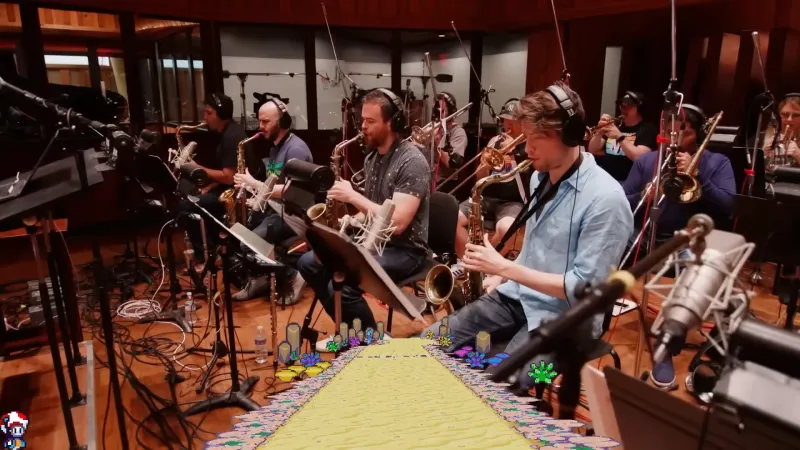
Four saxophonists play the music from Dolphin Shoals, a track in Mario Kart 8. Click the image to see the full song
“I write out the full orchestration, the chart, the arrangement, ahead of time,” Rosen explains. “And then when we get into the studio, especially for the rhythm section – so, guitar, piano, bass, and drums – they can be a little bit more free and interpretational with what I write, because it’s jazz, you know? I sort of give them more of a rough guideline. I don’t write out every single note of the bass line. I don’t write out every single drum fill. You just write the shape of the chart and what’s important to play.”
The other consequence of the piecemeal recording style is that each session has different musicians. Rosen estimates that any given recording probably only shares 65 percent of its musicians with the prior session, and that even though they only have around 35 people per track, albums can involve well over a hundred musicians.
Achievement Hunting
Five albums and almost eight years later, The 8-Bit Big Band has seen plenty of success, with none more exciting than its initial Grammy win in 2022. Rosen, who is a member of the Recording Academy (thanks to his “day” job), submitted the group’s “Meta Knight’s Revenge” cover for consideration. He says he recalls thinking, “This is the biggest long shot in the history of music, you know? But sure, I’ll submit my fun little video game music arrangements to the Grammy Awards.” Turns out, it wasn’t a long shot at all, and Rosen ultimately received the award for Best Arrangement, Instrumental or A Cappella.
The group was nominated again in 2025 with its rendition of “Last Surprise” from Persona 5, this time for Best Arrangement, Instruments and Vocals, but lost to vocal quartet säje. This year, the band is actually nominated twice; once for Best Arrangement, Instrumental or A Cappella again (for “Super Mario Praise Break”) and once for Best Large Jazz Ensemble Album (for Orchestra Emulator).
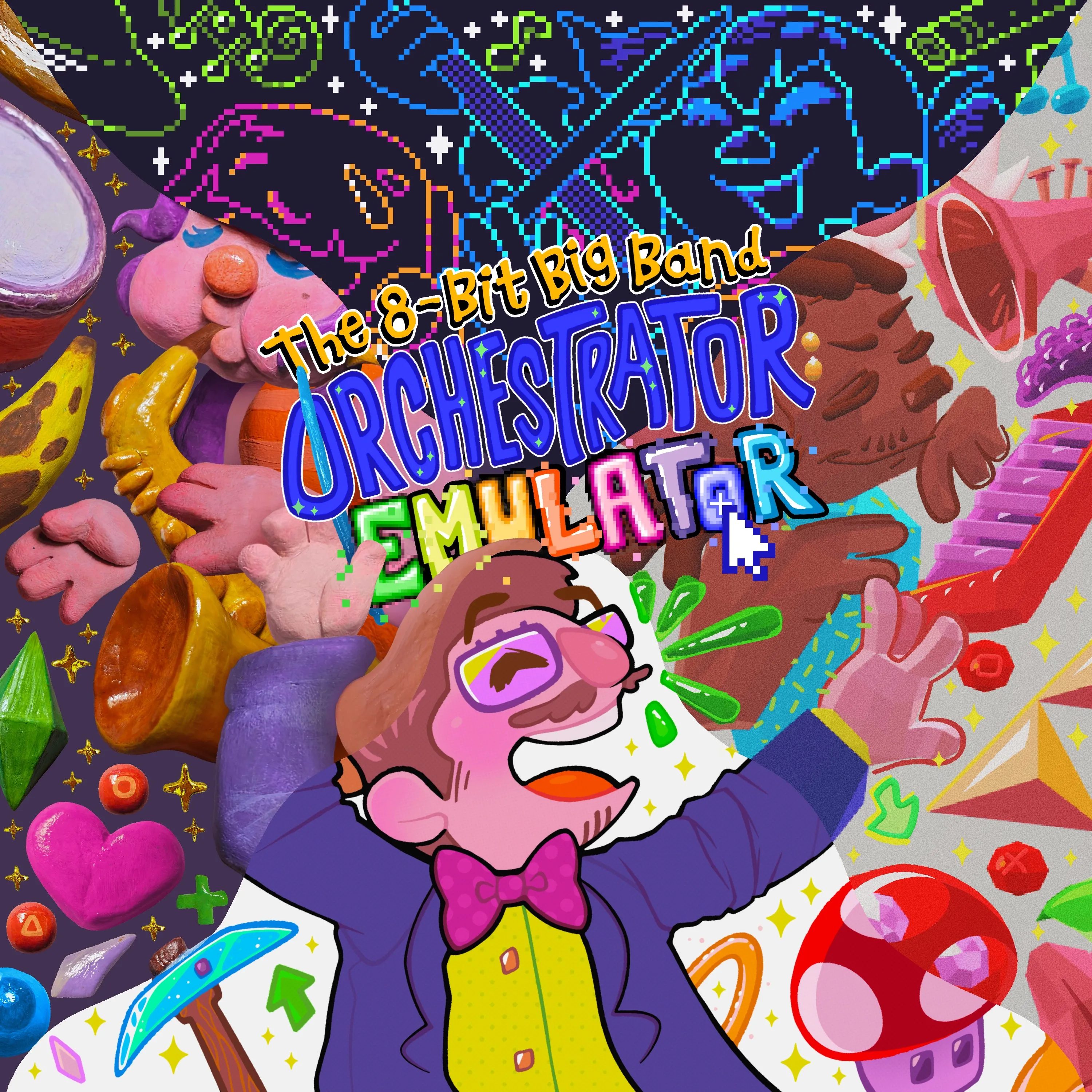
The cover of Orchestra Emulator, the band’s latest album.
“[T]hat is like, a traditional jazz category,” Rosen says, referring to Orchestra Emulator’s nomination. “That’s like– the other nominees are heavy-hitting jazz legends, so it’s pretty insane to be listed alongside them, to be honest.”
Of course, he’s also enthusiastic about “Super Mario Praise Break.” Just like with his first award, he’s the one who decides which tracks to submit for consideration, meaning this is an arrangement he’s particularly proud of.
“I submitted [“Super Mario Praise Break”] because it is just such a skillful example of what an arrangement is, which is just wildly recontextualizing a theme in a new way to showcase the quality of that theme in a completely different musical context,” Rosen says.
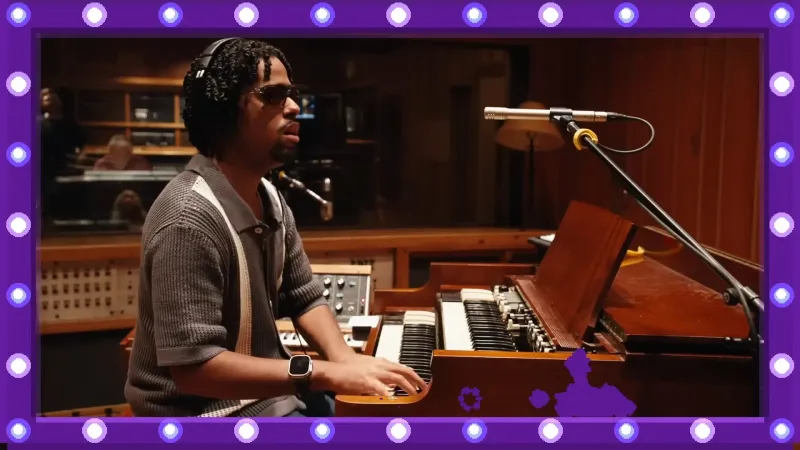
Matthew Whitaker plays the organ in The 8-Bit Big Band’s take on “Waluigi Pinball”
He also makes a point to credit his collaborators, Matthew Whitaker and Bryan Carter. Both grew up in the church, making them specifically qualified to write a praise break. Both also perform with the group, playing different instruments. Whitaker is an accomplished pianist, and you might recognize him from his organ performance on 8-Bit Big Band’s take on “Waluigi Pinball” (which has a bass line that sounds suspiciously like Herbie Hancock’s “Chameleon”). Meanwhile, Carter plays the drums and also worked with Rosen to orchestrate 2022’s Broadway show Some Like It Hot, for which the duo also won a Grammy.
While Rosen mentions this other Grammy in passing (he says he’s “gotten a couple” nominations for his “Broadway stuff”), our conversation never turns towards these other awards. They’re simply irrelevant, which is a funny thing to say about a Grammy in the context of someone’s musical career. It’s a nice reminder, though, that despite teasers of songs that might appear in the next album, it might still be a ways off. After all, despite the praise, the views, and the awards, this is only Rosen’s side gig.


